
Why Skin Type Shapes Everything
Most people approach facial skincare with careful intention - cleanser, toner, serum, moisturiser - yet apply whatever body lotion is on the shelf without a second thought. The problem is that body skin varies just as much as facial skin, and using the wrong formulation can leave skin either greasier, drier, or more irritated than before.
Before choosing a product or building a routine, it helps to understand what your body skin is actually doing. To understand the underlying distinction between drawing water into skin versus sealing it in, see our explainer on hydration vs moisture in skincare. If you are entirely new to building a routine from the ground up, Skincare From Scratch is a practical place to start.
~70%
Of body skin surface classified as barrier-prone
Dermatological literature broadly notes that the limbs - particularly the lower legs - are among the most frequently affected sites for dry skin across all age groups.
2-3 min
Post-bath window for optimal moisturiser absorption
This application window is cited in dermatological guidance for maximising the 'seal-in' effect of occlusives on residual surface moisture.
Dry Skin: Richer Formulas, Consistent Application
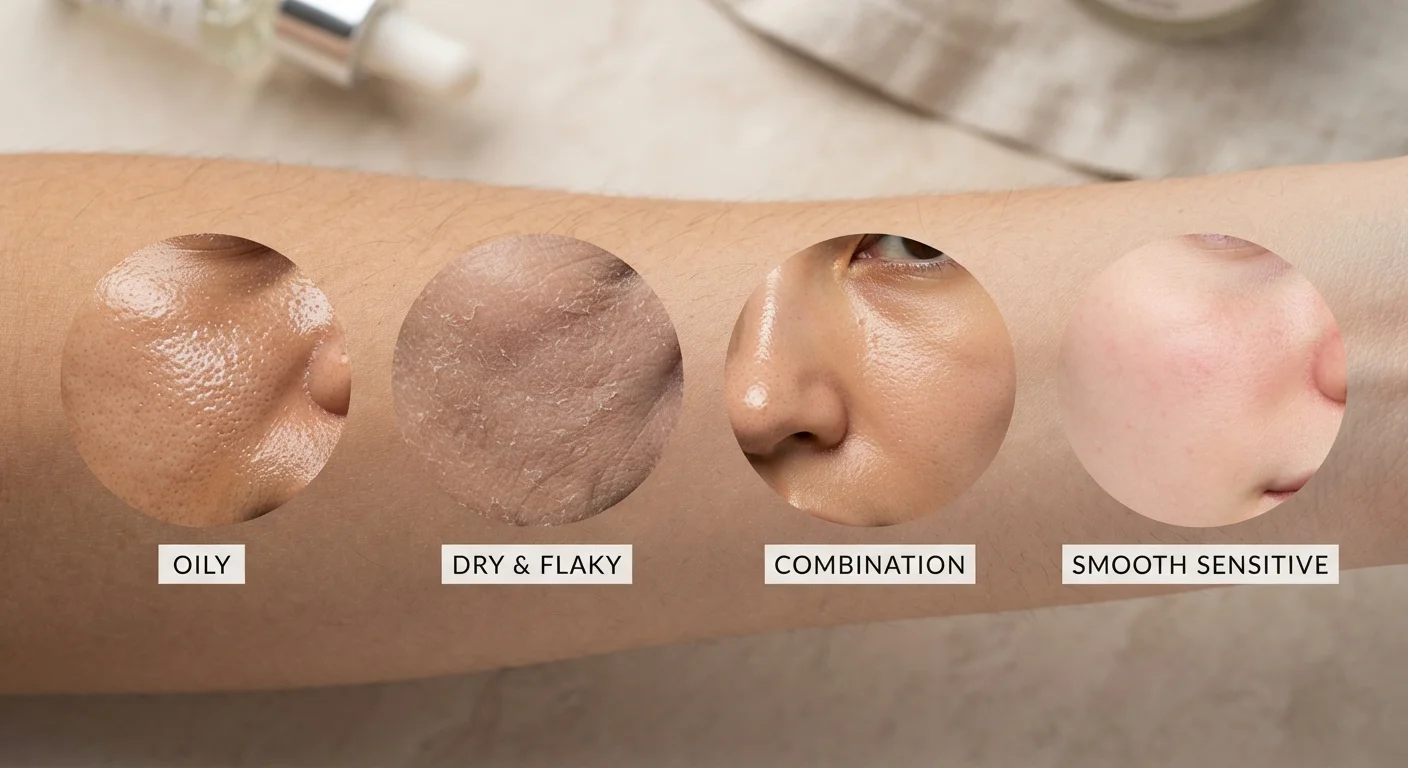
Dry body skin - characterised by flakiness, tightness after bathing, and a rough or dull texture - has a compromised skin barrier that loses water faster than it can retain it. The goal is to reinforce that barrier with a layered approach.
- Humectants first: Ingredients such as glycerin and hyaluronic acid draw moisture into the upper layers of skin. Apply these while skin is still slightly damp.
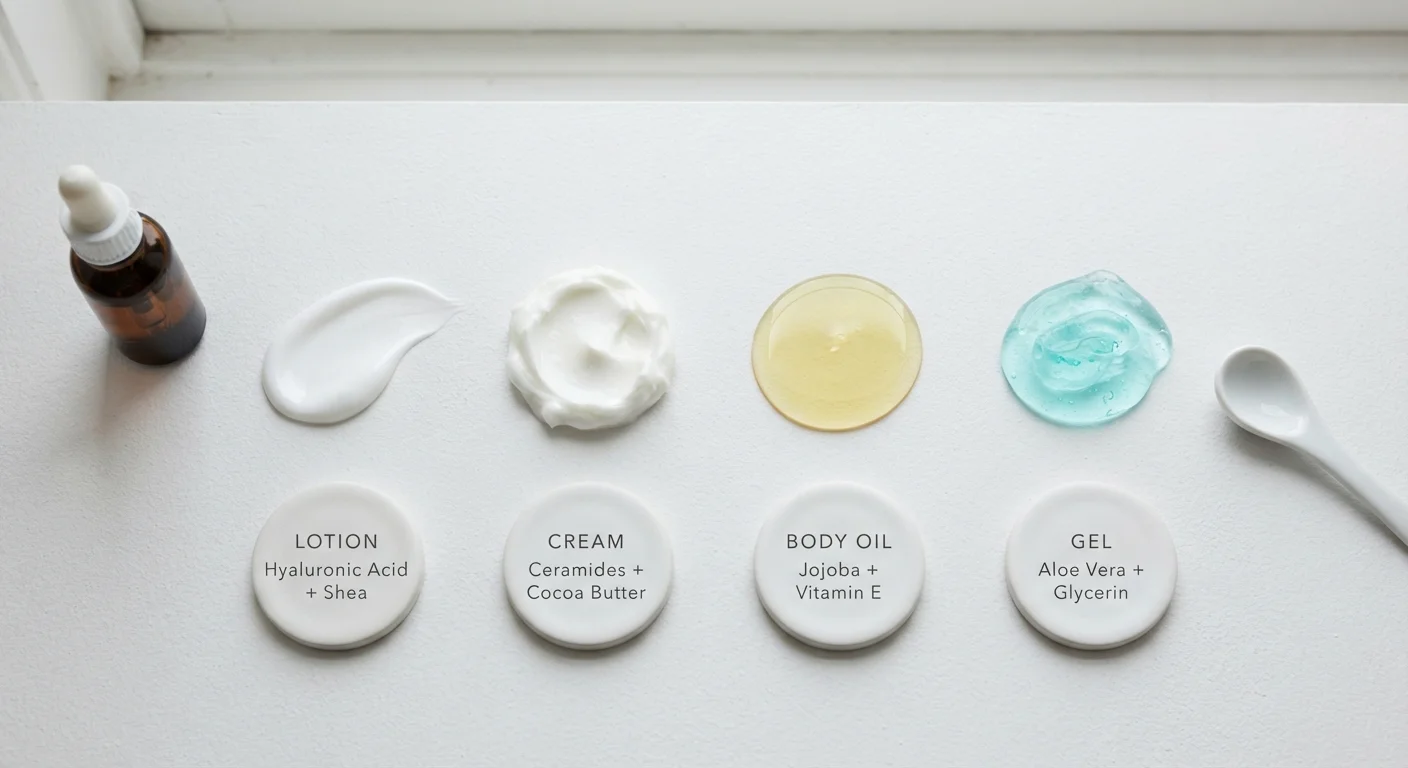
- Occlusives second: Shea butter, petrolatum, and dimethicone seal moisture in by forming a physical barrier over the skin surface. Creams and balms - not watery lotions - deliver these most effectively.
- Consistency over quantity: Twice-daily application, especially after bathing and before bed, outperforms heavy but infrequent use.
For very dry body skin, layer a liquid body oil underneath your cream rather than replacing it - the oil fills in microscopic surface irregularities and the cream then seals over the top more effectively.
This layering approach mimics how the skin's own lipid structure works: lighter lipids sit beneath heavier occlusives, maximising barrier reinforcement.
If your skin feels tight immediately after bathing but returns to normal within 20 minutes without moisturiser, your skin may be less severely dry than you think - a once-daily lotion may be enough rather than a heavy cream twice daily.
Over-moisturising can reduce the skin's own signalling to produce natural moisturising factors; calibrating product weight to actual need supports long-term barrier function.
Pay particular attention to the lower legs, shins, and hands, which tend to lose moisture most rapidly - especially in low-humidity environments or during winter months.
Oily Skin: Yes, Your Body Needs Moisture Too
Oily body skin - most noticeable on the chest, back, and shoulders - is often mistakenly skipped during moisturising. This is counterproductive: skipping moisture can trigger the skin to overproduce sebum as a compensatory response.
The solution is texture selection, not abstention. Look for:
- Gel-based or water-based lotions that absorb quickly without leaving residue
- Non-comedogenic labels - though note that the term is not regulated and varies by formulation
- Niacinamide-containing formulas, which have evidence supporting sebum regulation and are generally well-tolerated
Avoid heavy creams and oil-based balms on areas prone to breakouts. Light, fast-absorbing textures applied once daily - typically after showering - are usually sufficient for oily body skin.
A Light Touch Goes Further for Oily Body Skin
Apply a small amount of gel or lightweight lotion and allow it to absorb fully before dressing. If skin still feels tacky after two minutes, you have likely used too much. More product rarely improves outcomes for oily skin - texture and formulation matter far more than quantity.
Combination Skin: A Zone-Based Approach
Combination body skin - common across the trunk, where the chest and back can be oily while the arms and legs remain dry - benefits most from a targeted, zone-specific routine rather than a single product applied uniformly.
A practical framework:
- Apply a lightweight lotion or gel across oilier zones (chest, upper back).
- Use a richer cream on the arms, lower legs, and any noticeably dry patches.
- For elbows, knees, and heels - which are typically the driest zones regardless of skin type - a dedicated thick balm or urea-containing cream can address rough, thickened skin.
This approach does require two products, but it prevents the trade-off of under-moisturising dry areas or overloading oily ones. You can also adapt this strategy seasonally - seasonal changes in humidity and temperature often shift which zones need more attention.
Sensitive Skin: Fewer Ingredients, Greater Care
Sensitive body skin reacts to triggers - heat, friction, synthetic fragrance, preservatives - with redness, stinging, or itching. The objective here is to minimise exposure to potential irritants while still supporting the skin barrier.
Key principles for sensitive skin moisturising:
- Fragrance-free is non-negotiable for most people with skin sensitivity. This includes both synthetic fragrance and natural fragrance (such as essential oils), which can be equally reactive.
- Shorter ingredient lists reduce the risk of encountering a trigger.
- Ceramide-containing formulas are broadly well-tolerated and directly support the skin barrier's lipid structure.
- Patch testing new products on a small area for several days before full-body application is advisable.
Sensitive Skin Conditions Require Professional Guidance
If your skin reacts persistently to multiple products, or if you experience significant redness, weeping, or cracking, these may be signs of an underlying condition such as eczema or contact dermatitis. General moisturising advice cannot substitute for evaluation by a dermatologist. Please seek professional care for persistent or severe skin concerns.
For conditions such as eczema, psoriasis, or contact dermatitis, general moisturising guidance may not be sufficient. Our overview on grooming routines adapted for sensitive skin conditions covers adjusted approaches for those situations - though it is not a substitute for professional medical advice.
Body Zones That Need Extra Attention
Regardless of skin type, certain body areas have structural features that make them prone to dryness, roughness, or irritation:
- Elbows and knees
- Skin here is thicker and lacks sebaceous glands; it benefits from urea (typically 10-25%), lactic acid, or concentrated shea-based balms.
- Feet and heels
- The heels bear significant friction and pressure. Higher-concentration urea creams (20-40%) can help soften thickened skin over consistent use.
- Hands
- Frequent washing strips lipids rapidly. A cream with occlusive ingredients, reapplied throughout the day, helps maintain barrier function.
- Décolletage
- The chest area is often exposed to sun and environmental stress; lighter moisturisers with antioxidant or barrier-support ingredients are appropriate here.
Timing and Technique: Getting the Most From Your Routine
How and when you apply a body moisturiser can matter as much as which product you use. The principle of applying moisturiser to slightly damp skin - within two to three minutes of bathing - is supported by dermatological guidance. At that window, the skin surface retains residual water that the moisturiser can help lock in.
“Moisturiser is most effective when applied to skin that still has some water on the surface. The goal is occlusion - trapping that water before it evaporates.”
— American Academy of Dermatology, US-based professional body for dermatology education and clinical guidance
A few technique notes:
- Pat skin mostly dry with a towel rather than rubbing vigorously, which can disrupt a compromised barrier.
- Warm skin absorbs product more readily than cold, making post-shower application particularly effective.
- For the lower legs in particular, apply in an upward direction to encourage circulation.
For people managing both morning and evening routines, the AM and PM applications can serve different purposes. Our guide on morning vs evening skincare routines explores this principle in depth - and it applies to body skin as much as the face.
This article is for general informational and educational purposes only and does not constitute medical or dermatological advice. If you have a diagnosed skin condition or persistent concerns, please consult a qualified healthcare professional or dermatologist.