
Why Insulation Type Matters More Than You Might Think
Insulation is one of those home systems that does its job invisibly - until it doesn't. A mismatched insulation choice can leave cold spots, create moisture problems, or simply underperform against what you paid for. Understanding the four main categories helps you ask better questions before any work starts.
At the heart of every insulation comparison is the R-value - a measure of thermal resistance. Higher R-values mean greater resistance to heat flow. But R-value alone doesn't tell the full story. Air sealing, moisture management, and physical fit all affect real-world performance. For a deeper reference on materials and ratings, see our plain-language insulation reference guide.
It's also worth noting that insulation works best as part of a complete building envelope strategy. Sealing air leaks around windows and doors before or alongside insulation upgrades amplifies the benefit of both measures.
The Four Main Insulation Types Compared
Each type has a distinct physical form, installation method, and set of ideal applications. The comparison below breaks down where each performs well - and where it falls short.
| Blanket (Batt) | Loose-Fill | Spray Foam | Rigid Board | |
|---|---|---|---|---|
| Typical R-value per inch | R-3.1 to R-4.3 | R-2.2 to R-3.8 | R-3.7 to R-6.5 | R-3.8 to R-6.5 |
| Best locations | Open walls, attic floors | Finished walls, attics | Rim joists, crawl spaces | Basement walls, exterior sheathing |
| Air sealing ability | None on its own | Minimal | Excellent (closed-cell) | Moderate with taped seams |
| DIY friendliness | High | Moderate (rental blower) | Low (pro recommended) | Moderate |
| Moisture resistance | Low-moderate | Low-moderate | High (closed-cell) | High |
| Relative material cost | Low | Low-moderate | High | Moderate-high |
| Works in finished spaces | No | Yes | Partial | No |
A few important caveats apply to this overview. R-values vary by product thickness and density, not just material type. Installation quality also matters enormously - gaps, compression, and moisture intrusion can reduce effective R-value significantly regardless of which type you choose.
Blanket and Loose-Fill: The Most Common Choices
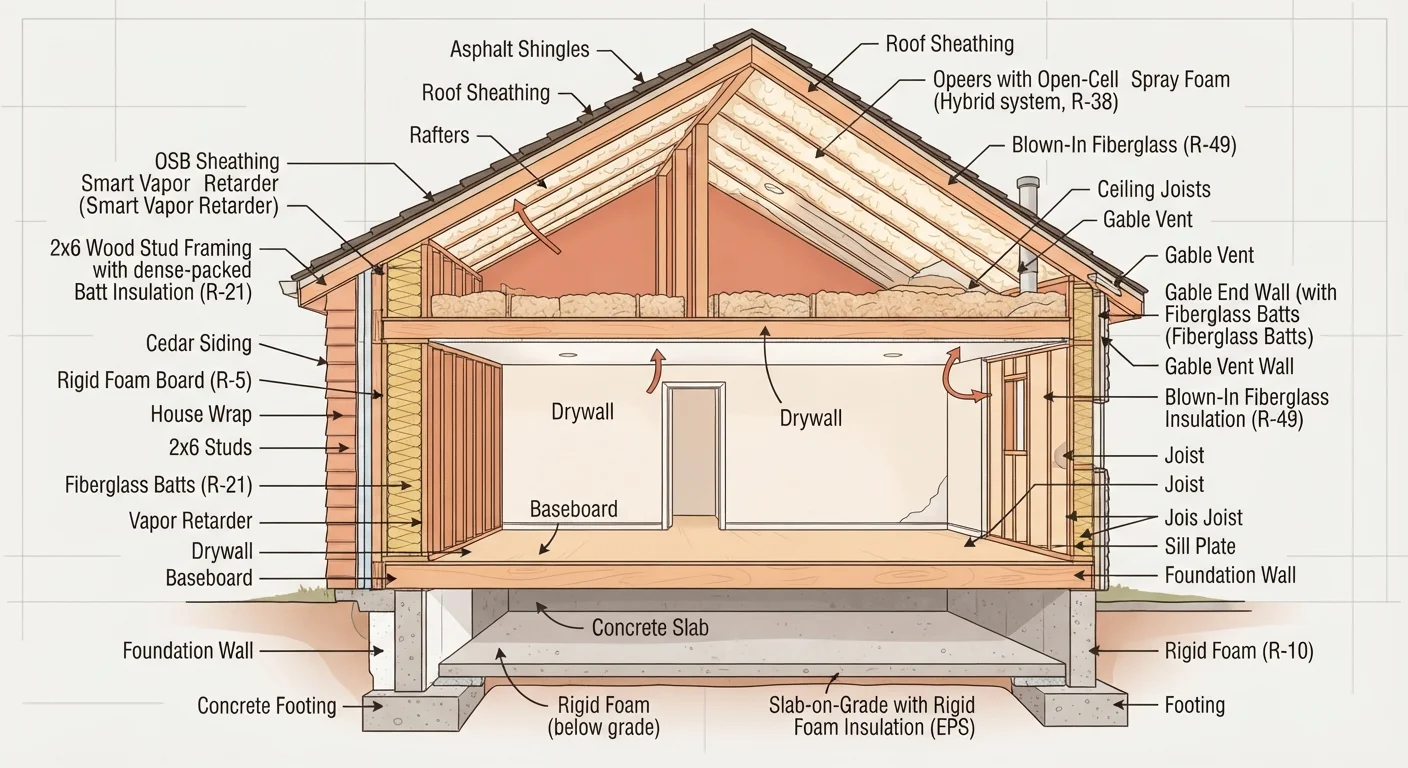
Blanket insulation - sold as batts or rolls, typically made from fiberglass or mineral wool - is the most widely installed type in US homes. It fits between standard-spaced wall studs, floor joists, and attic rafters. Because it comes pre-cut or in continuous rolls, installation in open, unobstructed cavities is relatively straightforward. It does not air-seal on its own, so it works best when paired with a proper air barrier.
Loose-fill insulation, blown in as cellulose, fiberglass, or mineral wool particles, is the practical solution when walls are already finished or an attic has irregular framing. Installers drill small holes to introduce the material without major demolition. Cellulose loose-fill, made primarily from recycled paper treated with fire retardants, is a popular option for attic floors due to its density and ability to conform around obstructions.
Check Existing Insulation Before Adding More
Before purchasing materials, measure what's already in your attic or walls. Adding insulation on top of moisture-damaged or compressed existing material won't solve underlying problems. A simple visual inspection - or a professional energy audit - can identify whether removal, air sealing, or a top-up is the right first step. This avoids wasting money layering new insulation over a compromised foundation.
Spray Foam and Rigid Board: Specialty Applications
Spray polyurethane foam (SPF) expands on contact, filling gaps and bonding to surfaces simultaneously. Closed-cell spray foam provides both high R-value per inch and a vapor retarder, making it well suited to rim joists, crawl space walls, and areas where moisture intrusion is a concern. Open-cell foam is softer, less dense, and more vapor-permeable - better suited to interior applications. Important: spray foam application requires proper respiratory protection and professional training. Most homeowners should hire a licensed contractor for anything beyond small canned-foam gap sealing.
Rigid foam board - available in expanded polystyrene (EPS), extruded polystyrene (XPS), and polyisocyanurate - delivers a high R-value in a thin, consistent panel. It's commonly used on basement walls, under slab floors, and as exterior continuous insulation behind cladding. Rigid board doesn't compress, doesn't absorb moisture as readily as fibrous types, and can be cut to fit with basic tools. However, most foam board products require a fire-rated covering (such as drywall) when used in interior occupied spaces - check local building codes before installation.
Note: Many insulation projects in conditioned living spaces require permits and must meet local energy codes. Always verify requirements with your local building department before beginning work.
Choosing the Right Type for Your Space
The decision usually comes down to three practical questions: Is the space open or already finished? Is moisture a significant concern? And what's the realistic budget for materials and labor?
~11%
Heat loss through uninsulated attics
The U.S. Department of Energy estimates that a significant share of home heating and cooling energy escapes through inadequately insulated attics and roofs.
R-38 to R-60
Recommended attic R-value in cold climates
The DOE's climate zone guidance recommends attic insulation levels of R-38 to R-60 for most northern US regions, depending on existing insulation.
For most attic upgrades in unfinished spaces, blanket batts or blown-in loose-fill are the most cost-effective starting points. For basements - especially below-grade walls where ground moisture is a factor - rigid board or closed-cell spray foam offers better long-term durability. Spray foam shines in hard-to-reach cavities and rim joists but represents a higher upfront cost.
If your home has open-concept spaces, insulation choices also interact with acoustic performance. Our article on open-plan living trade-offs covers how wall and floor assemblies affect both thermal and sound transmission.
Whatever type you choose, the insulation system only performs as designed when installed correctly, continuously, and without gaps. When in doubt, consult a certified home energy auditor or licensed insulation contractor before committing to materials or a scope of work.