
Why Daily Sun Protection Is Not Optional
Sunscreen sits at a unique intersection in skincare: it is one of the few topical habits with robust, long-running clinical evidence behind it. Unlike many ingredients that show promise in small or short-term studies, broad-spectrum sun protection has been examined across large populations and sustained periods, consistently linking daily use to measurably reduced skin cancer risk and slower photoaging progression.
The mechanism is straightforward. Ultraviolet radiation - specifically UVA (wavelengths 320-400 nm) and UVB (280-320 nm) - causes direct DNA damage to skin cells and generates reactive oxygen species that degrade collagen and elastin. UVB is primarily responsible for sunburn and plays a key role in skin cancer development. UVA penetrates more deeply and is the dominant driver of premature aging, including hyperpigmentation, fine lines, and loss of skin firmness. Critically, UVA intensity remains relatively stable throughout the day and across seasons, and it passes through window glass - meaning indoor exposure is a real, ongoing factor that many people underestimate.
For readers building evidence-informed routines, the logic is clear: UV damage accumulates over a lifetime, and daily protection interrupts that accumulation at every opportunity. See our guide to evidence-backed self-care for broader context on which skincare habits hold up to scrutiny.
This article is for general informational and educational purposes only. It is not a substitute for professional medical or dermatological advice. Consult a qualified healthcare professional for concerns about your skin health.
Best Practices for Effective Daily SPF Use
Knowing that SPF matters is only the starting point. How you use it determines whether the protection is real or mostly theoretical.
Choose a broad-spectrum sunscreen rated SPF 30 or higher for daily use.
The 'broad-spectrum' label indicates coverage of both UVA and UVB rays. SPF 30 blocks approximately 97% of UVB radiation; higher SPFs offer marginally greater protection but no product blocks 100%. SPF below 30 provides noticeably less UVB coverage and is not considered sufficient for meaningful daily protection by most dermatology guidelines.
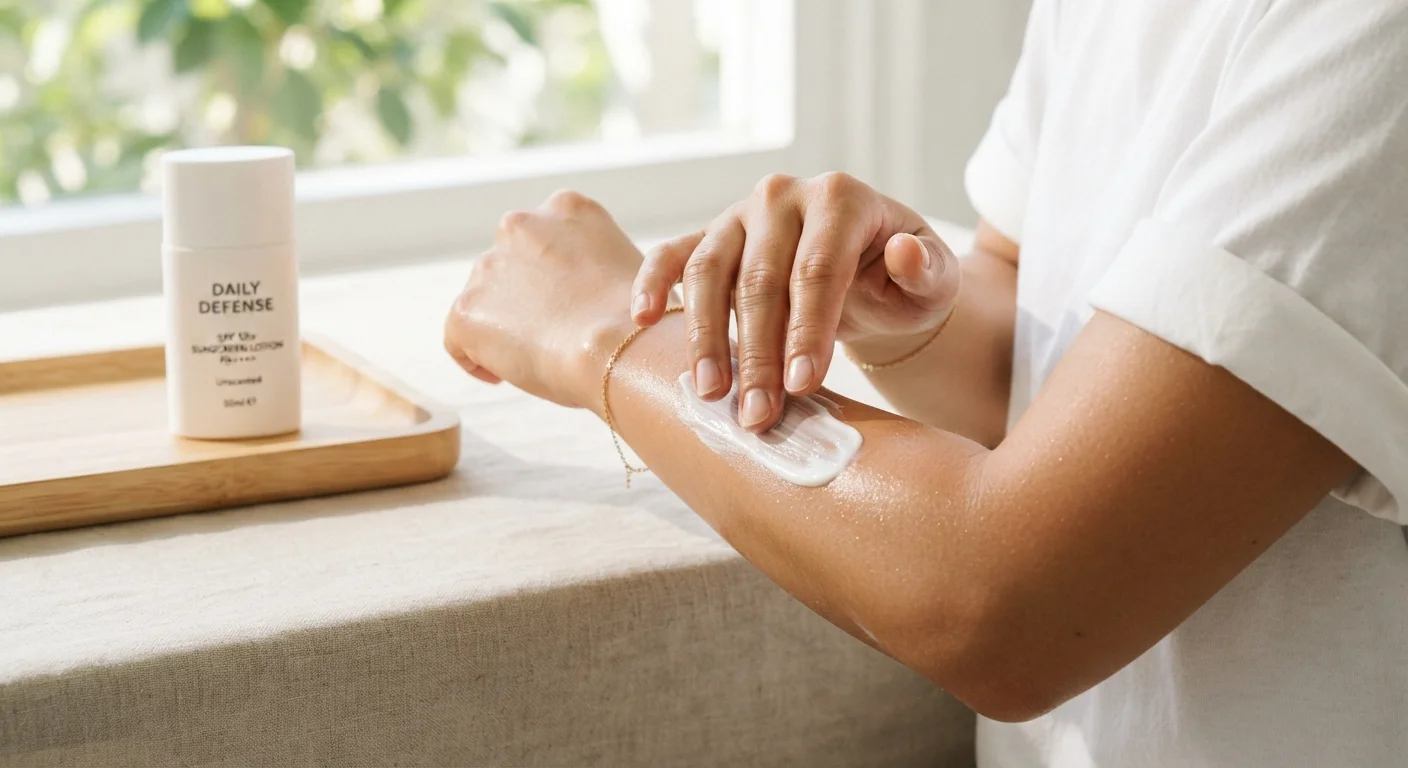
Apply sunscreen as the final step of your morning skincare routine, before makeup.
Sunscreen needs direct contact with the skin surface to form an effective protective layer. Applying it after moisturizer but before makeup allows it to function as intended without being diluted by layering products on top.
Use a sufficient quantity - about one-quarter teaspoon (1.25 ml) for the face alone.
SPF ratings are tested at 2 mg per square centimeter of skin. Most people apply far less, which significantly reduces the actual protection delivered. Under-application is one of the most common reasons sunscreen fails in practice.
Reapply every two hours during outdoor exposure, and after swimming or heavy sweating.
Sunscreen degrades with UV exposure, sweat, and physical contact. A morning application alone does not provide sustained protection throughout a day spent outdoors. Water-resistant formulas offer some additional durability but still require reapplication.
Do not skip SPF on cloudy days or when spending most of the day indoors near windows.
Up to 80% of UV radiation can penetrate cloud cover. UVA rays pass through standard window glass. Cumulative incidental exposure - during a commute, working near a window, or running errands - adds up over years even when no single exposure feels significant.
If you use active ingredients such as retinol or AHAs in your routine, consistent SPF becomes even more important - these ingredients can increase photosensitivity. Our breakdown of when actives actually earn their place explains how to sequence these steps safely.
Common Misconceptions That Undermine Consistency
Several widely held beliefs about sunscreen lead people to use it inconsistently or incorrectly - and understanding them helps prevent those gaps.
Indoor Exposure Is Still UV Exposure
Many people assume sunscreen is only necessary on sunny days spent outdoors. UVA radiation - the primary driver of skin aging - penetrates both clouds and standard window glass. If you work near a window or spend time in a car, you are receiving measurable UVA exposure throughout the day. This is why dermatologists generally recommend daily sunscreen application as a baseline habit regardless of weather or planned outdoor activity.
One persistent misconception is that darker skin tones do not need sunscreen. While higher melanin content does provide some natural UV protection, it does not prevent UV-induced DNA damage, and skin cancer - though statistically less common in people with darker skin - is frequently diagnosed at a later, more serious stage in these populations. Daily SPF is relevant across all skin tones. For a broader fact-check on common misunderstandings, see our article on skincare myths that persist despite the evidence.
Another misunderstanding involves SPF in makeup or moisturizers. These products often provide insufficient coverage when applied at realistic amounts - the SPF on a foundation label assumes a quantity most people do not use. A dedicated sunscreen layer beneath remains the more reliable approach.
Sustaining the Habit Long-Term
Evidence strongly favors consistency over perfection. A lower-SPF product applied every single day outperforms a high-SPF formula used only on obviously sunny days. The cumulative benefit of daily protection compounds meaningfully over years - and the cumulative cost of skipping it does the same.
~80%
UV radiation that penetrates cloud cover
The World Health Organization notes that up to 80% of UV rays reach Earth's surface even on overcast days, underscoring the need for sunscreen regardless of visible sunshine.
SPF 30
Minimum for meaningful UVB protection
Dermatology guidelines from organizations including the American Academy of Dermatology consistently identify SPF 30 broad-spectrum as the recommended daily minimum for the general population.
Integrating SPF into an existing morning routine - rather than treating it as an additional step - is one of the most effective strategies for long-term adherence. Our guide on making self-care rituals last explores why lower-effort, frequent habits typically produce better outcomes than sporadic intensive ones. Pairing sunscreen application with an already-established ritual, such as brushing teeth or applying moisturizer, leverages existing behavioral cues to support the new habit.
“The single most important thing people can do for their skin - in terms of preventing both premature aging and skin cancer - is to protect it from UV radiation every day, not just on beach days.”
— American Academy of Dermatology, Leading professional body for dermatology in the United States