

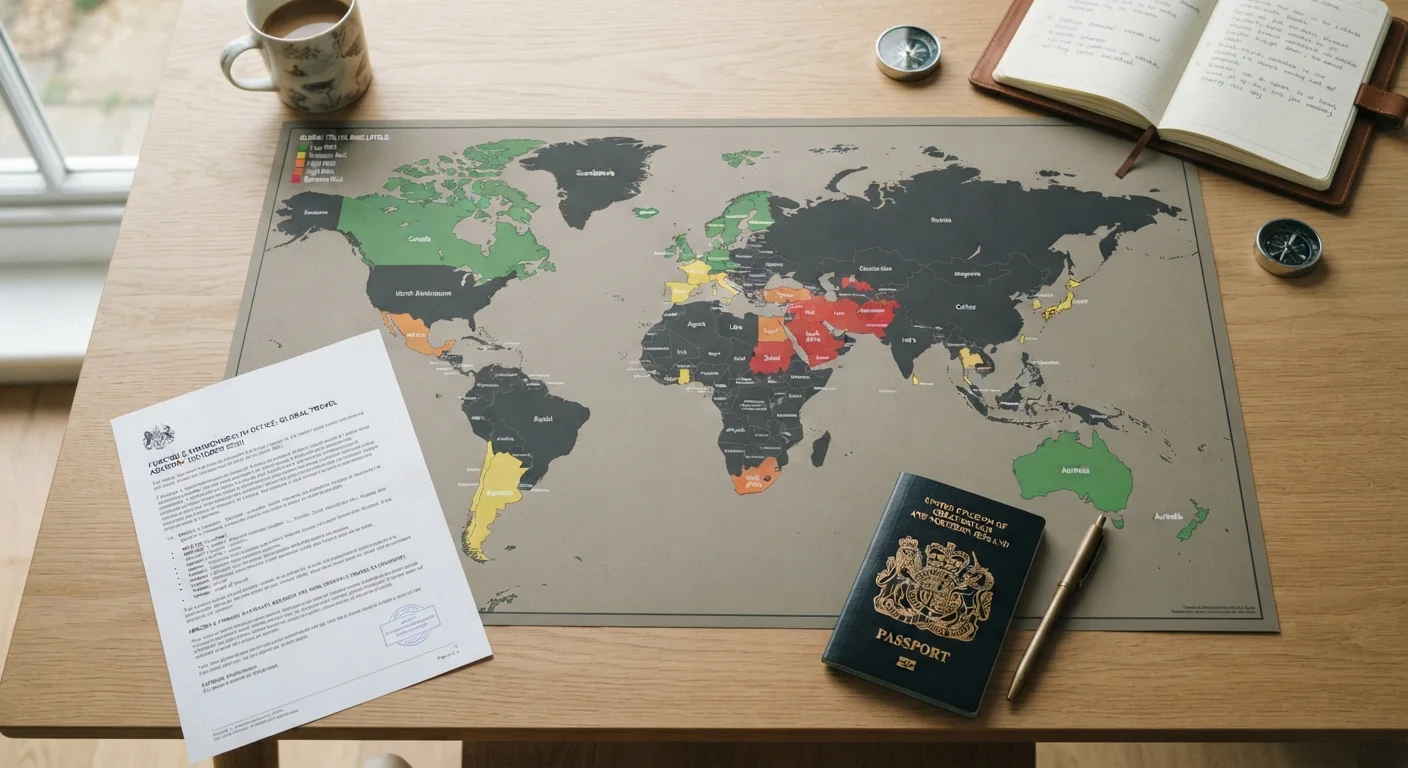
How Government Travel Advisories Work
The U.S. Department of State issues travel advisories for every country in the world, rating each on a four-level scale. These advisories synthesize intelligence from U.S. embassies, foreign government liaisons, and open-source monitoring — covering crime, civil unrest, terrorism, health crises, and natural disasters. They are updated as conditions change, sometimes within hours of a significant event.
Understanding what each level actually signals — rather than assuming they are either overcautious or alarmist — is a core skill for any informed traveler. For broader context on interpreting safety signals before a trip, see our guide to travel safety fundamentals.
| Issuing authority (U.S.) | U.S. Department of State |
| Number of advisory levels | 4 (Level 1 through Level 4) (U.S. Department of State) |
| Countries covered | Every country worldwide (U.S. Department of State) |
| Separate health advisory system | CDC Traveler Health Notices (Watch, Alert, Warning) (U.S. Centers for Disease Control and Prevention) |
| Where to find advisories | travel.state.gov |
| Update frequency | As conditions change; can update within hours of an event (U.S. Department of State) |
The Four Advisory Levels Explained
Each level represents a meaningfully different risk profile and calls for a different traveler response.
Level 1 — Exercise Normal Precautions
This is the baseline designation. It does not mean a destination is risk-free; it means the level of threat is comparable to what a traveler might encounter domestically. Standard situational awareness — securing valuables, staying informed, knowing your embassy's contact — remains appropriate.
Level 2 — Exercise Increased Caution
Certain risks are elevated at Level 2, whether due to petty crime, isolated civil unrest, terrorism concerns, or health issues. The advisory will usually specify which risks are driving the designation. Travelers should research those specific factors rather than treating the entire country as uniformly dangerous. Specific regions may carry higher sub-ratings.
Level 3 — Reconsider Travel
At this level, the State Department has identified serious, widespread, or unpredictable risks. This may include active conflict zones, kidnapping threats, or severe health emergencies. Travelers with non-essential purposes — tourism, for instance — are advised to weigh whether the trip is necessary. Those with professional or family obligations considering Level 3 destinations should review our article on traveling to high-risk destinations.
Level 4 — Do Not Travel
The highest designation is reserved for countries where the U.S. government assesses that risks to life and safety are severe and acute. Armed conflict, hostage-taking, and collapsed civil infrastructure are common drivers. U.S. embassies may have limited ability to provide consular assistance in these countries. Travel insurance policies and evacuation coverage may also be void or severely restricted for Level 4 destinations — verify directly with your provider.
Travel Advisory
An official government statement rating the safety risk of traveling to a specific country or region. The U.S. State Department uses a four-level system ranging from Level 1 (Exercise Normal Precautions) to Level 4 (Do Not Travel).
Consular Assistance
Help provided by a U.S. embassy or consulate to American citizens abroad, including emergency contact, passport replacement, and welfare checks. This assistance may be limited or unavailable in Level 4 countries.
CDC Traveler Health Notice
A public health advisory issued by the Centers for Disease Control and Prevention, rating disease or health risks at a destination on a three-tier scale: Watch, Alert, and Warning. These operate separately from State Department travel advisories.
Regional Sub-Rating
A separate advisory level applied to a specific province, city, or area within a country, reflecting that risk conditions vary significantly across different parts of the same nation.
What Advisories Don't Tell You
Advisory levels reflect national or regional averages. A Level 3 country may contain cities or regions that are comparatively stable, while a Level 1 country may have specific neighborhoods with elevated crime. Always read the full advisory text — not just the number — for regional breakdowns and specific threat types.
Advisories also don't capture every risk. Health-related precautions, for example, are addressed separately through CDC Traveler Health Notices, which use their own tiered system (Watch, Alert, Warning). Before travel, consult both sources. Our article on health precautions before international travel covers what those notices mean in practical terms.
It's also worth noting that some travelers assume advisories are systematically overcautious. Evidence doesn't consistently support that view — a point examined in our piece on common myths about staying safe abroad.
Always Verify Before You Travel
Advisory levels can change rapidly in response to elections, natural disasters, disease outbreaks, or security incidents. Check travel.state.gov and the CDC Traveler Health Notices within 72 hours of departure, not just at the time of booking. Also confirm your travel insurance policy's terms regarding coverage in elevated-advisory destinations, as exclusions are common and vary widely by provider.