

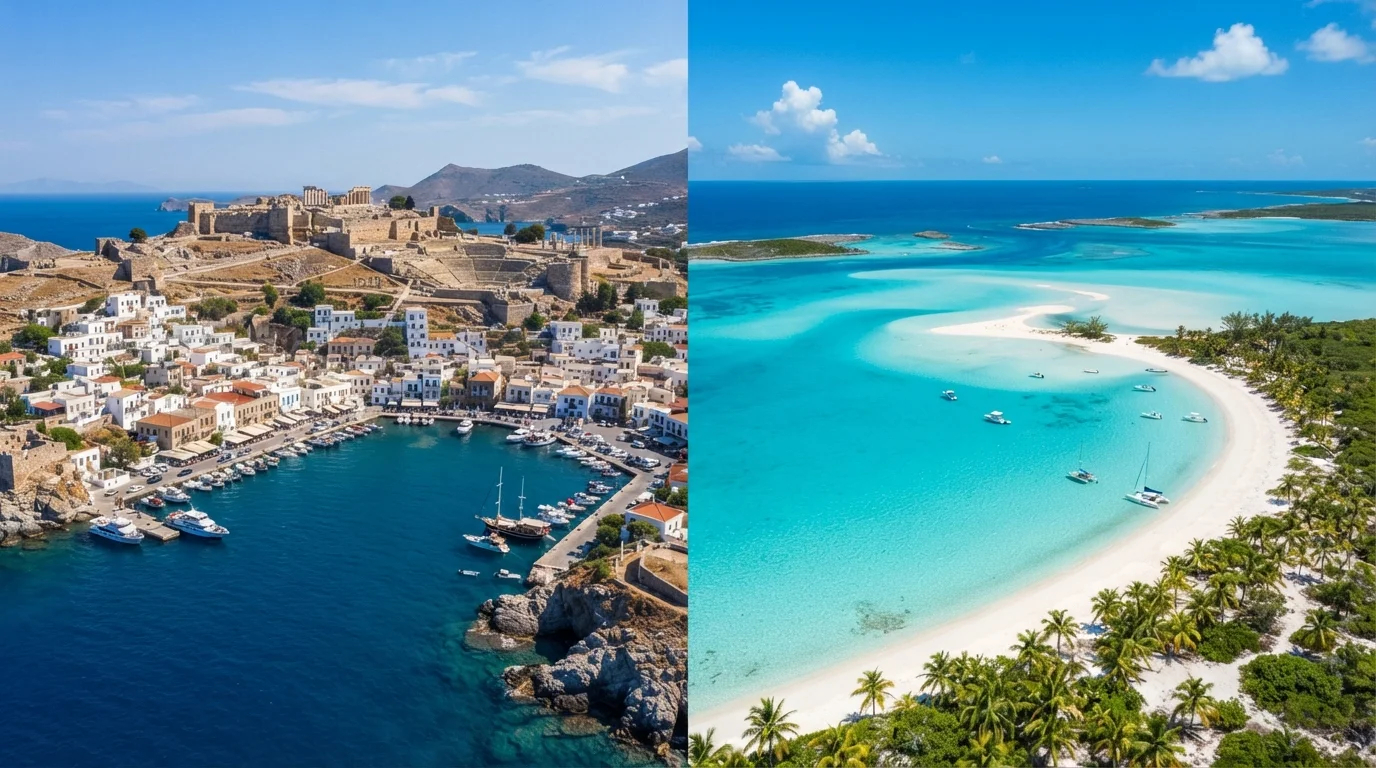
Understanding What Each Region Delivers
Choosing between a Mediterranean and Caribbean cruise ultimately comes down to what you want your days ashore to feel like. These are not interchangeable destinations - they represent fundamentally different travel philosophies delivered by sea.
The Mediterranean is the world's most historically layered cruise region. A single week-long sailing might include the ruins of Ephesus, a stroll through the streets of Kotor, and an afternoon in Rome's Trastevere neighborhood. Ports are dense with museums, archaeological sites, and local food culture. The tradeoff is pace: getting real value from each stop typically requires research and pre-planning, especially for high-traffic sites like the Acropolis or Sagrada Família.
The Caribbean trades that cultural density for sensory relaxation. Think turquoise water, coral reefs, open-air markets, and hammock-friendly afternoons. Port days are enjoyable without requiring a guidebook, and the overall rhythm is slower. For travelers who find aggressive sightseeing exhausting, that's a feature rather than a limitation. For more on how to decode what's actually packed into a cruise itinerary, see how to read a cruise itinerary.
| Criterion | Mediterranean Cruises | Caribbean Cruises |
|---|---|---|
| Primary appeal | History, culture, cuisine | Beaches, relaxation, water activities |
| Typical season | May - October | Year-round (best Oct - Apr) |
| US access | Transatlantic flight required | Many US homeports available |
| Port planning intensity | High - advance booking often needed | Low to moderate - flexible on arrival |
| Weather risk | Heat and crowds in peak summer | Hurricane risk June - November |
| Language barrier | Multiple languages across ports | English widely spoken in most ports |
| Best for families | Moderate - activity-dependent | High - accessible, flexible |
| Cultural immersion depth | Very high | Moderate |
Logistics, Seasons, and Getting There
For US-based travelers, Caribbean cruises hold a practical advantage: numerous homeports along the East Coast, Gulf Coast, and Florida mean many itineraries are reachable by car or a short domestic flight. This significantly reduces the total cost and complexity of the trip. Mediterranean cruises, by contrast, typically require a transatlantic flight, usually into Barcelona, Rome, Athens, or Lisbon - adding cost and jet lag to the equation.
Seasonality plays a meaningful role in both regions. The Mediterranean cruise season runs roughly from May through October, with shoulder months offering fewer crowds but sometimes reduced port services. Summer sailings - particularly July and August - can bring intense heat and heavy tourist traffic at key sites, which may affect how much you can comfortably see ashore.
The Caribbean is far more year-round, though the Atlantic hurricane season (June through November) introduces weather risk, particularly for the Eastern and Southern Caribbean. Many experienced cruisers prefer sailings in the Western Caribbean during peak hurricane months, or opt for itineraries in October through April when conditions are most predictable. For a detailed breakdown of what each Caribbean sub-region offers, see our region-by-region Caribbean guide.
18M+
Annual passengers on Caribbean itineraries
The Caribbean consistently ranks as the world's most popular cruise region by passenger volume, according to the Cruise Lines International Association (CLIA).
Top 5
Mediterranean among most visited cruise regions globally
CLIA has consistently listed the Mediterranean among the five most in-demand cruise destinations for North American travelers.
6-14 days
Typical Mediterranean itinerary length
Most Mediterranean sailings run longer than Caribbean equivalents, reflecting the distances between key port cities across Southern Europe and North Africa.
Who Each Cruise Style Actually Suits
Neither cruise region is universally superior - the right choice depends on your travel priorities, group composition, and tolerance for planning intensity.
Mediterranean cruises reward travelers who do their homework. Port days are short relative to the volume of things worth seeing; lines at major attractions are real; and getting from the cruise terminal to the actual city center can involve time and logistics. Travelers who enjoy that kind of engaged exploration - and who might supplement a cruise with pre- or post-sailing land days - tend to find the Mediterranean deeply satisfying.
Caribbean cruises are generally more approachable for families, first-time cruisers, and those who value flexibility over structure. Most port towns are walkable from the pier, English is widely spoken, and activities ranging from snorkeling to rum tastings require minimal advance booking. If you're traveling with people across a wide range of ages or interests, the Caribbean's variety makes it easier to keep everyone engaged. Our guide on cruising with different age groups explores this dimension in more detail.
For travelers intrigued by longer voyages or unconventional routes - perhaps using a transatlantic repositioning sailing to reach either region - it's worth understanding what repositioning cruises involve before assuming a standard itinerary is your only option.
Travel conditions, entry requirements, and health advisories can change. Always verify visa, vaccination, and safety information with official government and travel provider sources before booking or departing.