

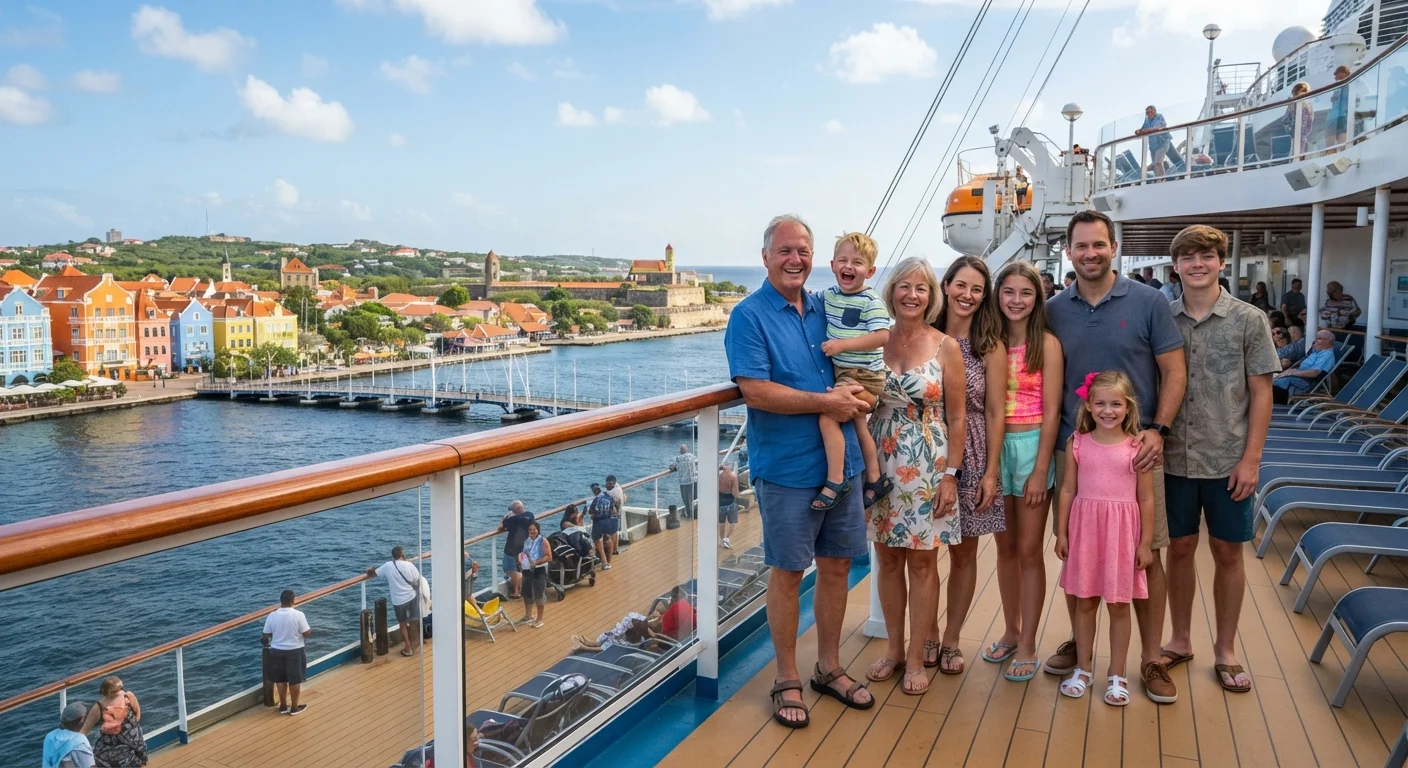
Why Itinerary Choice Is the First Decision for Multi-Generational Groups
Booking a cruise for a group that spans toddlers, teenagers, working adults, and grandparents is genuinely complex. Each age group brings different energy levels, interests, and physical limits - and the itinerary you choose will either accommodate those differences or create friction throughout the trip. Before comparing ports, it's worth understanding how to read an itinerary on its own terms. Our guide to reading cruise itineraries explains how port schedules, tender stops, and time-in-port details affect your actual experience on the ground.
When everyone in your group has an opinion - and they will - the logistics of alignment matter too. See our group travel logistics guide for practical strategies on coordinating decisions. Below are the itinerary types and destinations most likely to work across generations, along with honest notes on their tradeoffs.
Short Caribbean Loops (5-7 Nights)
A five- to seven-night Caribbean itinerary departing from a US homeport remains the most accessible starting point for multi-generational groups. Embarkation is straightforward, passport requirements are simpler for minors, and the trip length doesn't exhaust young children or older travelers before the holiday has properly begun.
Ports like Nassau, St. Thomas, and Cozumel have well-developed infrastructure - wide pier access, accessible shore excursion options, and enough variety that a teenager and a grandparent can choose entirely different activities and reunite for dinner onboard. Beach days require minimal logistics and tend to satisfy the widest range of ages simultaneously.
One practical consideration: confirm whether your ports are dock stops or tender stops. Tendering - transferring to a small boat to reach shore - can be challenging for guests with limited mobility and requires patience when managing young children. Our Caribbean region-by-region breakdown notes which ports typically use tenders.
Short Caribbean loops minimize travel fatigue while maximizing accessible port options for every age group.
Alaska Inside Passage
Alaska cruises offer a fundamentally different kind of multi-generational appeal: the scenery does much of the work. Glacier viewing, wildlife spotting from the ship's deck, and fjord transit are low-effort, high-impact experiences that engage grandparents and young children in a way that culture-heavy European itineraries often don't.
Ports such as Ketchikan, Juneau, and Sitka are compact, walkable, and offer excursions ranging from gentle whale-watching tours to more active kayaking or hiking options - allowing different family members to self-select appropriately. Juneau, notably, is only accessible by sea or air, which adds a sense of genuine adventure without requiring physical exertion.
Weather and layering are real considerations. Alaska cruises run roughly late April through September, and even summer days can be cool and overcast. Families with very young children should factor in nap schedules and the reality that glacier viewing may involve extended deck time in cold wind.
Alaska's scenery requires no itinerary compromise - watching glaciers calve is compelling at any age.
Norwegian Fjords
For groups with older teens and adults across multiple generations, the Norwegian fjords represent one of the more genuinely awe-inspiring itineraries available. The scenery - steep cliff walls, waterfalls, small wooden villages - unfolds slowly as the ship navigates narrow waterways, making sea transit itself the attraction rather than a gap between ports.
Bergen is the most common embarkation point for European travelers, though many US travelers position this as a post-transatlantic add-on or fly into Oslo and embark there. Shore excursions tend to emphasize scenic train journeys, such as the Flåm Railway, and village walking tours - manageable for most mobility levels, though always worth verifying accessibility in advance.
Families with children under seven may find the fjords more visually compelling in concept than in practice - young children often respond more viscerally to beaches and marine life than to cliff scenery. For a broader comparison of European versus Caribbean cruise experiences, see our Mediterranean vs. Caribbean guide.
The Norwegian fjords turn the ship's transit into the experience - no shore excursion required to feel the impact.
Mediterranean with Flexible Shore Days
Mediterranean itineraries carry a reputation for being adult-oriented, but they can work well for multi-generational groups when shore time is planned deliberately rather than ambitiously. The common failure mode is over-scheduling: trying to cover an ancient ruin, a hilltop village, and a coastal lunch in a single port day with a mixed-age group that includes someone in a wheelchair and a four-year-old in a stroller.
The better approach is to treat each port as requiring a single anchor activity. In Rome (Civitavecchia), that might be the Vatican or the Colosseum - not both. In Barcelona, it might be Las Ramblas and the waterfront, with a clear endpoint for the day. Older teens and adults who want more depth can arrange their own time, while grandparents and younger children return to the ship for rest and onboard programming.
Ports in this region vary significantly in accessibility and ease of navigation. Split, Croatia, for example, involves cobblestone streets that are difficult with strollers and mobility aids. Verify specifics before committing to independent exploration.
In the Mediterranean, choosing one anchor activity per port prevents the exhaustion that kills multi-generational harmony.
River Cruises for Adult-Skewing Multi-Generational Groups
When the group skews older - say, adults in their 30s through 70s with no young children - European river cruises offer a genuinely compelling format. The smaller ship size, dock-in-town experience (no tenders), and immersive port stops create a pace that suits travelers who want cultural depth without the scale of a large ocean vessel.
Rivers such as the Danube, Rhine, and Douro connect cities and small towns in ways that feel coherent rather than disconnected. A multi-generational adult group can take the same walking tour at different paces, split off to different cafés, and converge again for a scheduled departure - all without coordinating transportation or taxis.
The tradeoff is clear: river cruises are not well-suited to families with young children. Ship programming for kids is essentially nonexistent, and the itinerary pace assumes adults who can walk several miles per port day. Our river vs. ocean cruise comparison lays out the structural differences in detail.
River cruises eliminate tender logistics entirely and deliver cultural immersion at a pace that suits adult generations well.
Making the Final Call for Your Group
No single itinerary is perfect for every multi-generational configuration. A family with a five-year-old and an 80-year-old grandparent has very different needs than a college graduation trip spanning 20-somethings and their 60-year-old parents. The goal isn't to find a cruise that thrills everyone equally - it's to find one that excludes no one critically.
Build in Designated Rest Time
Multi-generational itineraries work best when sea days are treated as intentional recovery, not wasted travel time. Onboard programming - pools, kids' clubs, lectures, spa facilities - allows each age group to decompress independently. Scheduling at least one or two sea days into any itinerary over seven nights significantly reduces the friction that comes from group fatigue.
If your group includes seasoned cruisers who want something beyond the standard loop route, our overview of repositioning cruises is worth a read - though these long-haul voyages are generally better suited to adults without young children in tow. For destination comparisons that help narrow your region, see our Mediterranean vs. Caribbean breakdown and our region-by-region Caribbean guide.