
Why a System Beats Willpower Every Time
Most people approach organization as a motivation problem - they just need to feel inspired enough to tackle the clutter. In practice, motivation is unreliable. A well-designed system, however, works whether you're energized or exhausted, because it removes the need for repeated decision-making.
The core insight is this: disorganization isn't a character flaw, it's a design failure. When items don't have a clearly defined home, they end up wherever is convenient in the moment. Over time, those convenient spots become permanent, and chaos compounds. A functional organization system solves for human behavior rather than fighting it.
Before buying a single bin or label, it helps to understand the three-layer logic that underpins every durable organization system: zones define where things live, containers group and contain them, and labels communicate the system to everyone in the household. Together, these elements make order self-reinforcing. For a broader framework covering the entire process, see this end-to-end home organization guide.
Zone
A dedicated area within a room assigned to a specific activity or item category, designed so everything needed for that function lives together.
Prime real estate
The most accessible storage locations in a space - eye-level shelves, front-of-drawer slots, countertop areas - reserved for the most frequently used items.
Category integrity
The discipline of keeping only items that belong to a defined category within a given container or zone, preventing drift and mixed-use clutter.
System reset
A brief, scheduled routine (daily or weekly) that returns items to their designated zones and prevents small accumulations from compounding into major disorder.
Frequency layering
Organizing storage so that daily-use items are easiest to reach and rarely used items are stored in harder-to-access spots.
Dead zone
A storage area that is difficult to access - such as the back of a deep cabinet or a high overhead shelf - typically best reserved for seasonal or rarely used items.
Zoning: The Foundation of Functional Space
A zone is a dedicated area of your home tied to a specific activity or category of items. The kitchen might contain a baking zone near the stand mixer, a coffee zone beside the coffeemaker, and a snack zone at a lower cabinet accessible to children. Each zone keeps everything needed for that function together, so you're never hunting across multiple drawers mid-task.
Effective zoning follows a few reliable principles:
- Activity proximity: Store items where you use them, not where you first think to put them.
- Frequency layering: Daily-use items occupy prime real estate (eye level, front of shelf). Rarely used items move to harder-to-reach spots.
- Like with like: Group items by function or category rather than by aesthetics alone.
Zoning works across every room - a mudroom entry zone for shoes, bags, and keys; a homework zone at the kitchen table with supplies nearby; a charging zone in a consistent drawer. The goal is that returning something to its place requires no thought at all. For strategies on maintaining zones in a shared household, see organizing shared spaces with different standards.
Start with One Zone Before Tackling the Whole Home
Resist the urge to reorganize every room at once. Choose one high-friction zone - a junk drawer, a pantry shelf, or an entryway hook - and apply the full zone-container-label sequence there first. A successful small-scale implementation builds confidence and reveals what adjustments to make before scaling the system across your home.
Bins and Containers: The Logic Behind the Hardware
Containers are the most over-purchased and under-thought element of home organization. The common mistake is buying attractive bins first, then trying to fit belongings into them. The correct order is always: sort and categorize first, measure the space second, then shop for containers.
When evaluating containers, consider three practical factors:
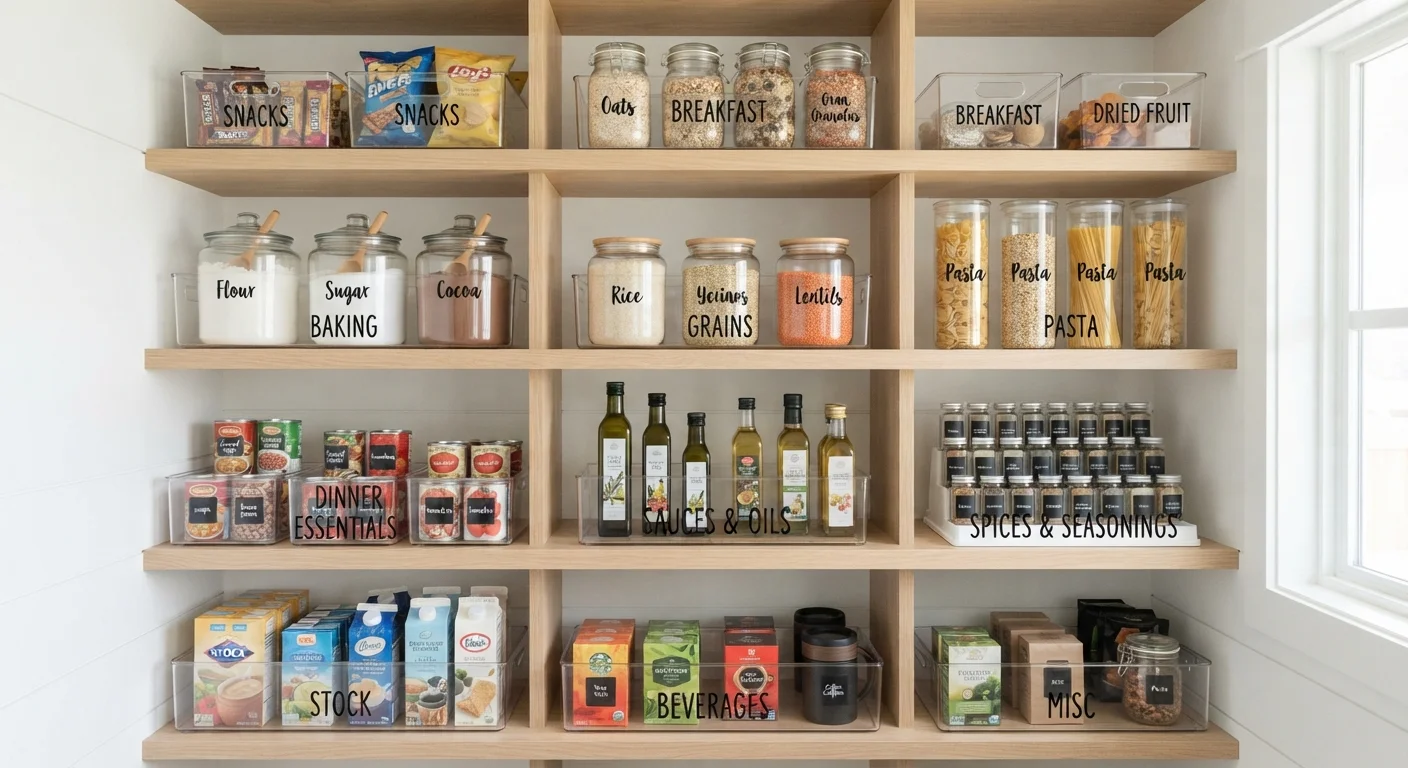
- Visibility: Clear containers work well in pantries and medicine cabinets where you need to identify contents at a glance. Opaque bins suit areas where visual uniformity matters more than instant identification.
- Access frequency: Lids make sense for items stored infrequently. Open-top bins suit daily-use categories where a lid would create friction and discourage put-away.
- Stackability and fit: Modular containers that stack and nest maximize vertical space and maintain flexibility as your needs evolve.
Container size should match category size - not the available shelf. A bin that's too large invites overfilling and mixed categories. A bin that's too small forces overflow, defeating its purpose. When in doubt, smaller containers with clearer category definitions outperform large catch-all storage.
Don't Let Containers Become the System
Attractive storage products can create the illusion of organization without delivering its function. If you can't immediately identify what's in a container and locate what you need, the container is decorative, not organizational. Prioritize clear categories and logical placement over aesthetic uniformity.
Labeling: Making the System Speak for Itself
Labels do cognitive work so household members don't have to. Without them, a well-designed zone erodes within weeks because no one agrees on - or remembers - where things belong. Labels create shared understanding and distribute ownership of the system.
Useful labels are specific. "Pasta & Grains" is more actionable than "Food." "Permission Slips & Forms" is clearer than "Papers." Vague labels invite incorrect items and blur category boundaries over time.
Consider your household's needs when choosing label format:
- Text labels work well for adult-only households and spaces accessed primarily by the same person.
- Icon or image labels support children, visual learners, or anyone who doesn't read the primary household language.
- Color-coded labels can assign ownership in shared spaces - each family member's zone marked in their color.
For a full glossary of organization vocabulary used across labeling and system design, see the complete home organization terminology reference.
Putting It All Together: From Concept to Habit
Understanding zones, bins, and labels as a unified system - rather than three separate tasks - is what separates a one-time tidy from a lasting organizational structure. The sequence matters: zone first, contain second, label third. Reversing or skipping steps produces systems that look organized momentarily but collapse under daily use.
Maintenance is the final and often ignored layer. A good system builds resets into routine rather than requiring heroic effort. A nightly five-minute sweep, a weekly zone check, and a monthly category audit keep accumulation from undoing months of work. When something repeatedly ends up in the wrong place, treat it as data - the zone or container may need adjustment, not just enforcement.
If you're beginning from a state of significant clutter, address that first. A room-by-room decluttering walkthrough will help you reduce the volume of belongings before you build systems around what remains. And if common organization advice hasn't worked for you, it may be worth reviewing which organization myths waste time and space before investing further effort.
Systems Require Adjustment, Not Perfection
No organization system works perfectly from day one. Expect to refine zone boundaries, resize containers, and update labels as your household's habits and needs evolve. A system that gets tweaked regularly is healthier than one treated as fixed - adaptability is part of what makes it sustainable.