
Why Organization Has Its Own Language
Home organization has developed a working vocabulary of its own - shorthand terms, borrowed concepts, and named methods that help households describe, plan, and maintain their systems. Knowing what these terms mean isn't just useful for reading articles or watching videos: it makes conversations with co-inhabitants clearer and gives you a framework to diagnose what's working and what isn't.
This reference guide defines the most widely used terms across organization methodology, spatial logic, and habit design. Whether you're conducting a whole-home organization audit or building a system with housemates who have different standards, a shared vocabulary is a practical foundation. See the core logic of functional home organization for how these concepts connect in applied systems.
These Terms Describe Systems, Not Styles
Home organization terminology spans method, habit, and spatial thinking - not aesthetic trends. You don't need to adopt a particular visual style (minimalist, maximalist, Scandinavian) to benefit from these concepts. The vocabulary here is tool-neutral and applicable to any household size, budget, or living situation.
Key Terms Defined
The definitions below cover spatial concepts, rotation methods, decluttering philosophies, and everyday habits. They are arranged by theme rather than alphabetically to make relationships between ideas easier to follow.
Dead Zone
Any area in a home that collects clutter but serves no intentional purpose - think the corner of a bedroom or the back of a cabinet. Identifying dead zones is a first step toward reclaiming usable space.
Prime Real Estate
Storage locations that are easiest to access - at eye level, within arm's reach, near entryways or work areas. These spots should hold the items you use most frequently.
FIFO (First In, First Out)
A rotation method borrowed from inventory management: older items are placed at the front so they get used before newer ones. Most commonly applied to pantry food and cleaning supplies.
Swedish Death Clean (Döstädning)
A Swedish decluttering philosophy that encourages people to gradually sort and reduce their possessions - not as a morbid exercise, but to simplify life for both themselves and those who will eventually manage their belongings.
Zoning
The practice of assigning specific areas of a room or home to specific activities or categories of items, so that everything has a designated location and retrieval becomes intuitive.
Decision Fatigue
The mental exhaustion that results from making too many choices in succession. In home organization, reducing the number of items you own or standardizing storage containers can help limit daily decision fatigue.
Decanting
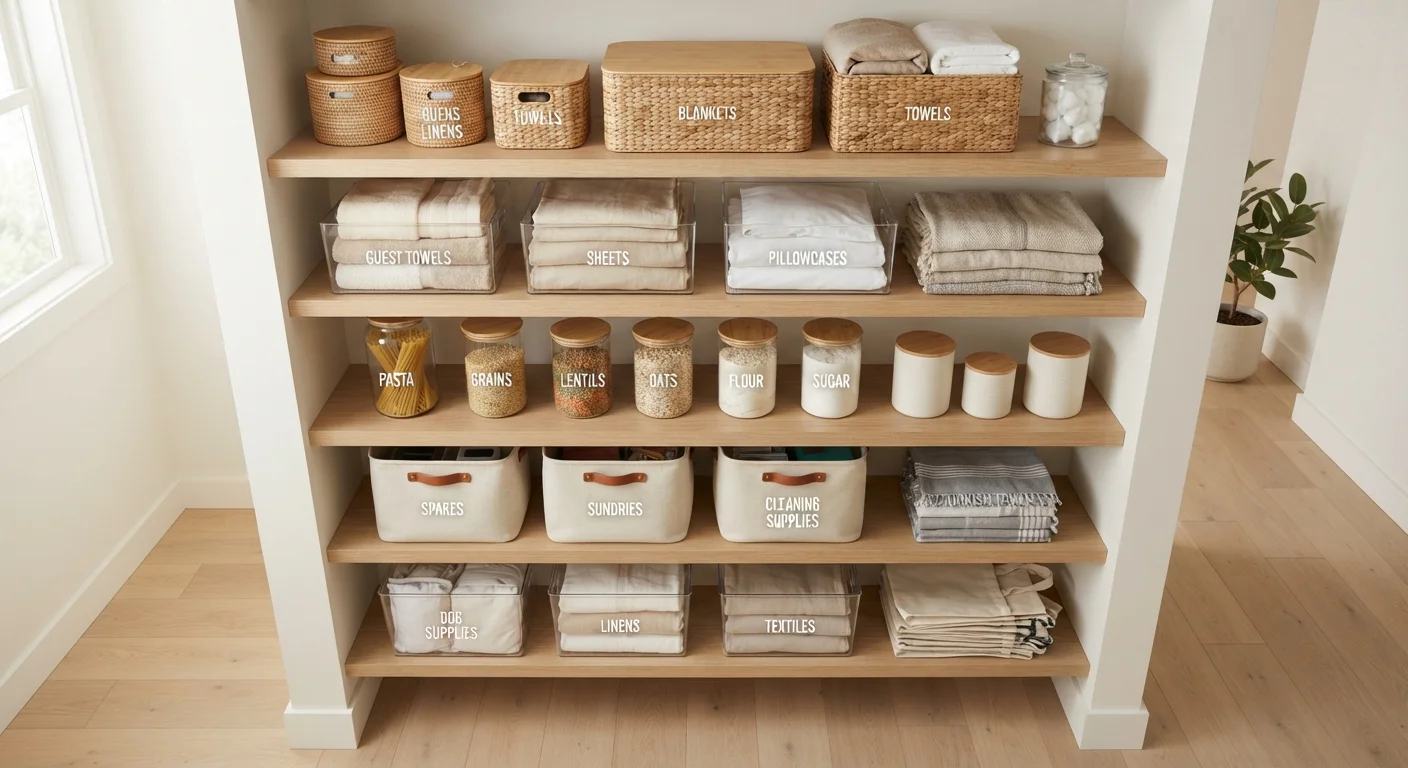
Transferring products - such as cereals, pasta, or cleaning solutions - from their original packaging into uniform, labeled containers. Decanting improves visual consistency and often maximizes shelf space.
Command Center
A dedicated wall or surface area - often near an entry or in a kitchen - that centralizes household communication, including calendars, mail, keys, and to-do lists.
One-In-One-Out Rule
A maintenance habit where one item is donated or discarded every time a comparable new item enters the home. It prevents gradual accumulation without requiring periodic purges.
Visual Noise
The sense of disorder or overwhelm created by too many visible, mismatched, or randomly placed objects in a space. Reducing visual noise often involves consolidating, concealing, or standardizing what is on display.
Touch-It-Once Principle
An efficiency rule suggesting items should be dealt with immediately upon first handling - filed, put away, or discarded - rather than set down temporarily and revisited later.
Negative Space
Empty, intentional gaps in shelving, drawers, or countertops. Maintaining negative space signals a system is not at capacity and leaves room for the home to function without becoming immediately overwhelmed by new items.
For a broader framework that puts many of these concepts to work together, the comprehensive end-to-end organization framework is a practical next step.
At a Glance: Quick Reference
Use the card below for fast lookups on key facts associated with the terms in this guide - including origins, applications, and common usage contexts.
| Origin of 'Döstädning' | Swedish; translates roughly to 'death cleaning' (Popularized internationally by Margareta Magnusson's 2017 book) |
| FIFO primary use case | Pantry and perishable goods rotation (Adapted from commercial food service and warehouse management) |
| Typical prime real estate height range | Between shoulder and hip height (General ergonomics and kitchen design guidelines) |
| Command center placement | Most effective near home entry or kitchen hub (Home organization practitioners' consensus guidance) |
| One-In-One-Out frequency | Applied per item category (clothing, books, kitchenware, etc.) |
25%
Of two-car garages that can't fit a single car
According to the U.S. Department of Energy, roughly one in four two-car garages is too cluttered to park in - illustrating the scale of storage mismanagement in American homes.
~$10B
Annual U.S. self-storage industry revenue
The Self Storage Association estimates the sector generates around $10 billion annually, suggesting many households are paying to store items that organization systems might help them reduce.
Understanding these facts helps you contextualize why certain methods - like FIFO or the one-in-one-out rule - gained traction and how they translate to everyday household practice. If you share your home with others, these systems work best when everyone uses the same terminology; the guide on organizing a shared home explores how to align different habits and standards under one roof.