
The Real Reason Your Drawers Never Stay Organized
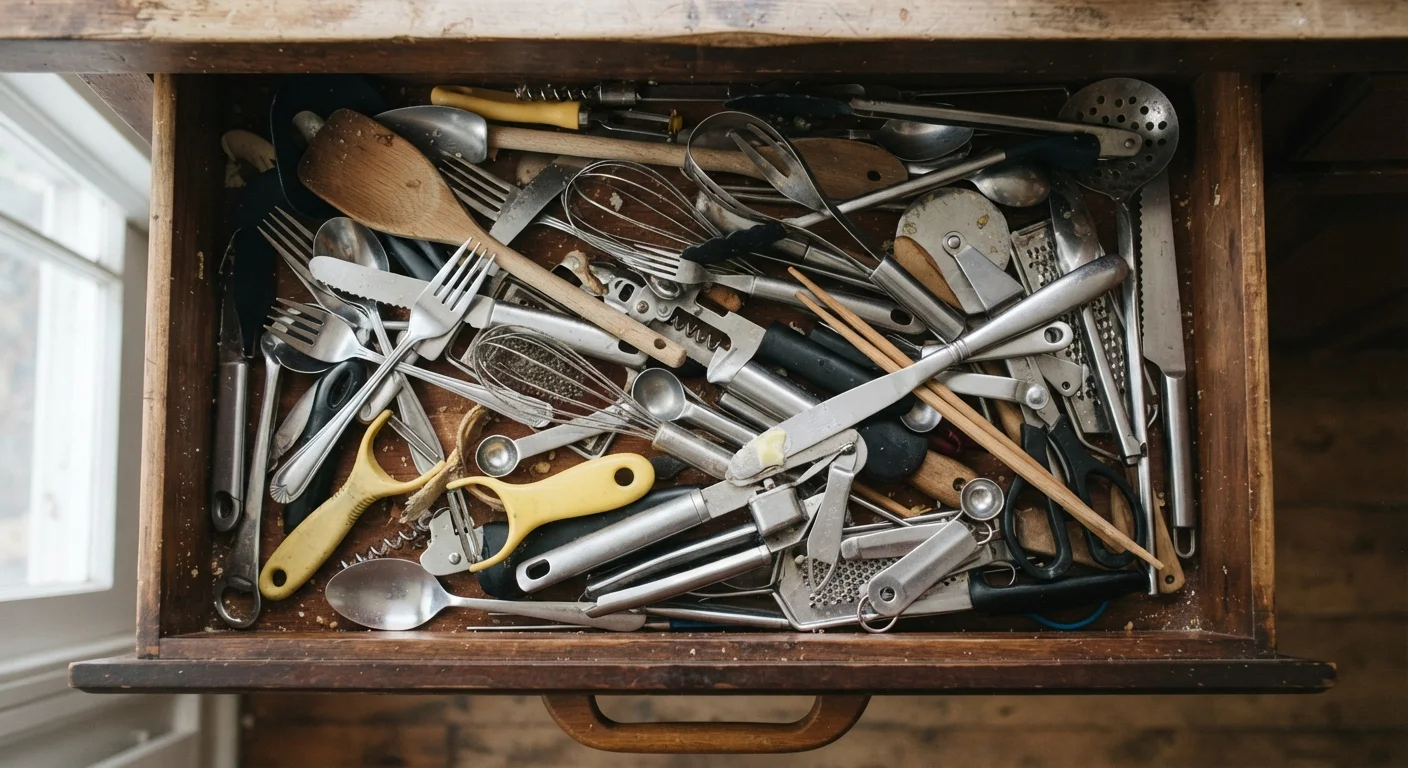
If you've reorganized the same kitchen drawer twice in six months, the problem isn't your motivation - it's your method. Most kitchen drawers descend back into disorder for structural reasons that have nothing to do with willpower. The system itself is fighting against the way your household actually moves through a kitchen.
Understanding the specific mistakes that cause this cycle is the first step toward breaking it. The fixes are rarely expensive or complicated. What they require is an honest look at how your kitchen functions day to day - not how you wish it did.
The psychology behind why clutter accumulates explains how cognitive habits and decision fatigue contribute to this pattern at a deeper level - worth reading alongside these practical fixes.
Organizing before decluttering.
Why it happens: It feels productive to sort and containerize right away. Decluttering feels slow and emotionally harder, so people skip it and go straight to arranging what they have.
Using dividers that don't match the actual contents.
Why it happens: Generic divider sets look neat in photos, but kitchen tools vary wildly in size. People buy fixed-grid trays that fit silverware perfectly but can't accommodate a ladle, a peeler, and a garlic press simultaneously.
Grouping items by category instead of by task.
Why it happens: Sorting 'all the spatulas together' or 'all the measuring spoons together' feels logical. But it ignores how kitchens actually work: you grab tools in task-driven combinations, not categories.
Packing drawers too full, leaving no buffer space.
Why it happens: Kitchen storage is often limited, and people resist using a second drawer when everything 'fits' in one - even if it's jammed. A full drawer looks organized at first glance.
Building a system only you understand.
Why it happens: The person who organizes the drawer creates a system that makes sense to them. Other household members - children, partners, housemates - put things back where they think they go, which quietly dismantles the order.
Treating a one-time overhaul as a permanent solution.
Why it happens: A big organization session feels like a finish line. In reality, kitchens are high-traffic, high-use spaces where contents shift constantly. Without a light maintenance habit, entropy takes over within weeks.
Building a System That Actually Holds
Once you've identified which of these mistakes are sabotaging your drawers, the path forward becomes straightforward. The goal isn't a perfect drawer - it's a drawer that's easy enough to maintain that tidiness becomes the default, not the exception.
30%
Time wasted searching for kitchen tools
Research on household time use consistently finds that searching for misplaced items is among the most common daily time losses in home kitchens.
2 min
Weekly reset time to prevent full chaos
Organization experts broadly recommend micro-maintenance sessions of two minutes or less as the most sustainable way to preserve kitchen order long-term.
A few principles hold across almost every kitchen: group items by task (not by category), keep the most-used tools in the easiest-reach positions, and make putting things away marginally easier than leaving them out. That last point is deceptively powerful.
If your one-in-one-out habits aren't yet in place, your drawers will continue filling up regardless of how well you've sorted them. Acquisition habits and organization systems work together - neither is sufficient alone.
Don't Reorganize Around Items You Should Remove
A common trap is purchasing new organizers to accommodate items that should simply be discarded or donated. More containers don't solve an excess-items problem - they disguise it temporarily. Before investing in any organizing product, ask whether each item genuinely belongs in that drawer at all. Organization myths that waste time and space covers this pattern in detail, including why more storage rarely solves underlying clutter.
For a broader framework that covers your entire home rather than just the kitchen, the end-to-end home organization framework is a useful companion resource.