

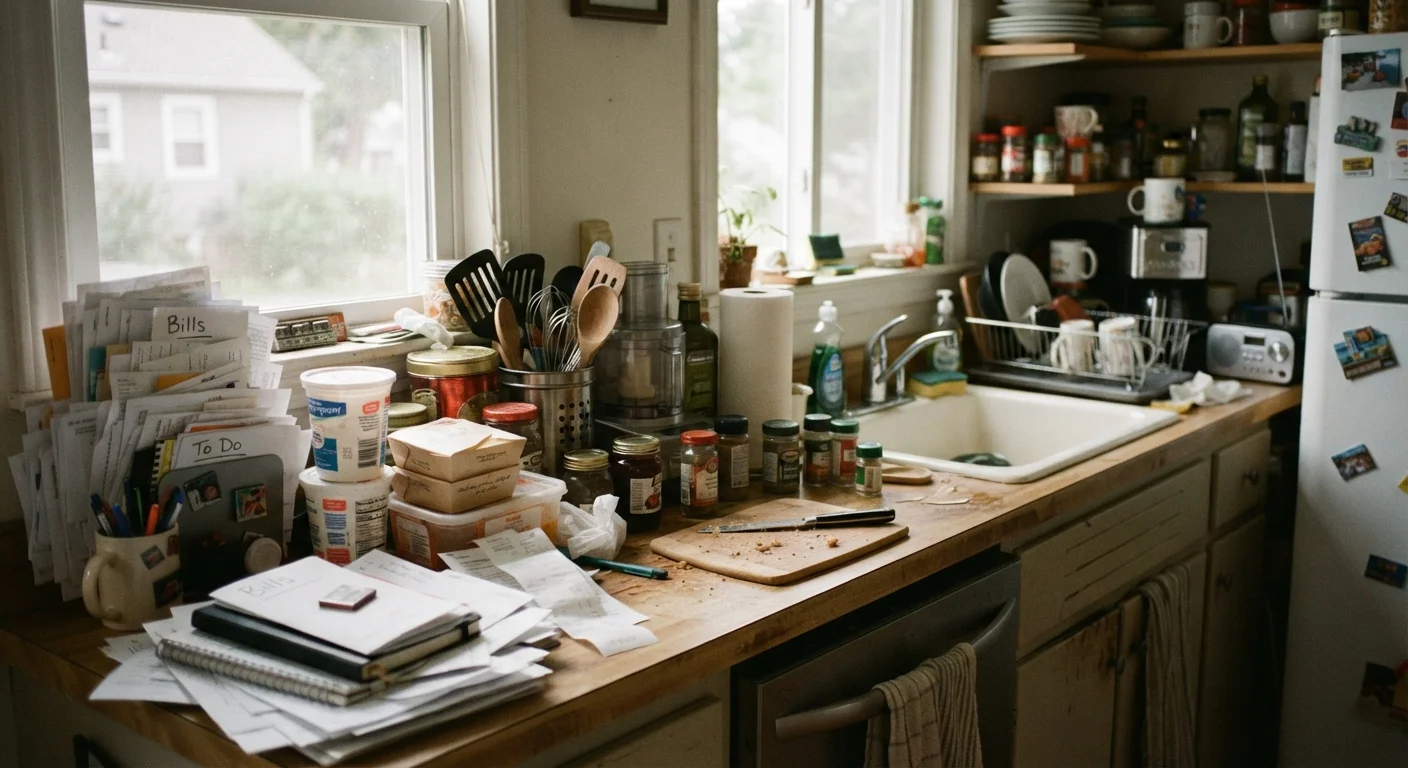
The Decision Problem at the Heart of Clutter
Most clutter doesn't arrive in dramatic moments. It accumulates through thousands of tiny deferred choices: the mail set on the counter instead of sorted, the bag placed by the door instead of unpacked, the purchase kept "just in case." At its core, clutter is a decision backlog made physical.
Psychologists describe this as decision avoidance - the tendency to postpone choices when they feel uncertain, effortful, or emotionally charged. The brain experiences even small decisions as a cost, and when that cost feels high relative to the urgency, deferral wins. The object lands on the nearest flat surface, and the decision is pushed to "later."
This pattern compounds through decision fatigue, a well-documented phenomenon in which the quality of decisions deteriorates after sustained mental effort. By evening, after a full day of choices, the cognitive bandwidth needed to sort, assign, or discard is often depleted - making avoidance the path of least resistance.
Design Your Space to Decide Less
Assign a specific, clearly defined home to every category of item before clutter builds up. When every object has an obvious place, the cost of the 'where does this go' decision disappears - dramatically reducing the chance of surface accumulation. This is one of the most evidence-supported structural changes you can make to a living space.
Understanding this dynamic reframes clutter not as a character flaw but as an organizational design problem. Systems that reduce the number of decisions required - clear homes for every object, simple intake routines - make consistent tidiness significantly more sustainable. See our comprehensive home organization framework for how to design these systems deliberately.
Emotional Attachment and the Weight of Objects
Not all clutter is the result of indecision - some of it is the result of very deliberate holding on. Objects become repositories for memory, identity, and emotion. A stack of hobby supplies represents who someone intends to become. A gift kept out of obligation carries a relationship's weight. Clothes from a previous life stage signal an identity not quite released.
Behavioral economists call the broader mechanism the endowment effect: people consistently assign higher value to things they already own than to identical items they don't. This isn't irrational sentiment - it's a reliable feature of how the mind accounts for loss. Discarding an object registers as a small loss, and the brain is wired to weight losses more heavily than equivalent gains.
Guilt Is a Clutter Driver
Items received as gifts or inherited from family members often persist in homes long past their usefulness because releasing them feels like ingratitude or betrayal. It helps to recognize that an object's emotional significance lives in the memory and relationship - not in the physical item itself. Releasing an object does not release the connection it represents.
Guilt is a particularly overlooked driver. Items received as gifts, inherited belongings, or purchases that "seemed like a good idea" often persist long past usefulness because letting them go feels like an admission of waste or ingratitude. Recognizing guilt as a clutter driver - rather than a sound reason to keep something - is a meaningful shift in perspective.
This is also why simple purging advice like "if you haven't used it in a year, toss it" frequently fails. It addresses the object without addressing the emotional logic holding it in place. For a more grounded approach, see home organization myths that waste time and space.
Environmental Cues and the Normalization of Disorder
Clutter also self-perpetuates through a well-studied phenomenon: environmental normalization. Once a space becomes cluttered, the disorder itself signals that further accumulation is acceptable. A clear countertop creates social pressure to keep it clear; a cluttered one removes that pressure entirely. Each new item added to an already-cluttered space requires almost no decision - it simply joins the existing pile.
54%
Americans overwhelmed by home clutter
A survey by the National Association of Professional Organizers found that approximately 54% of Americans feel overwhelmed by the amount of clutter in their homes.
80%
Of clutter is never used again
Professional organizers commonly cite estimates suggesting roughly 80% of items people keep 'just in case' are never retrieved or used for their intended purpose.
2x
Loss aversion weight vs. equivalent gain
Behavioral economics research, including foundational work by Kahneman and Tversky, consistently finds that losses feel roughly twice as significant as equivalent gains - a key driver of difficulty discarding possessions.
This is compounded by visual habituation - the brain's tendency to stop registering familiar stimuli. People living with chronic clutter often report that they stop "seeing" it, which reduces the discomfort that might otherwise motivate action. The clutter becomes ambient, part of the background, until a particular stressor (a visitor arriving, a search for a lost item) makes it visible again.
In shared homes, these dynamics interact with differing personal thresholds, making the problem more complex. What reads as chaos to one person is comfortable context to another. Organizing shared spaces with different standards requires understanding each person's clutter psychology, not just negotiating whose stuff is where.
From Understanding to Action
Recognizing the psychological roots of clutter shifts the solution set. Rather than relying on willpower or periodic purges, durable organization depends on designing around these tendencies - reducing decision points, building emotional permission to let go, and disrupting environmental normalization before it sets in.
Concrete strategies follow from this understanding. Limiting intake, rather than only managing what accumulates, addresses the problem upstream. The one-in-one-out rule and long-term tidiness habits directly counteracts the endowment effect by building the decision to release into the moment of acquisition. For those ready to work through existing accumulation systematically, decluttering your home room by room provides a structured framework that prevents overwhelm.
The goal isn't a perfectly minimalist home - it's a home where the environment supports rather than drains the people living in it. That starts with understanding why things pile up in the first place.