
What Counts as a Minimalist Skincare Routine?
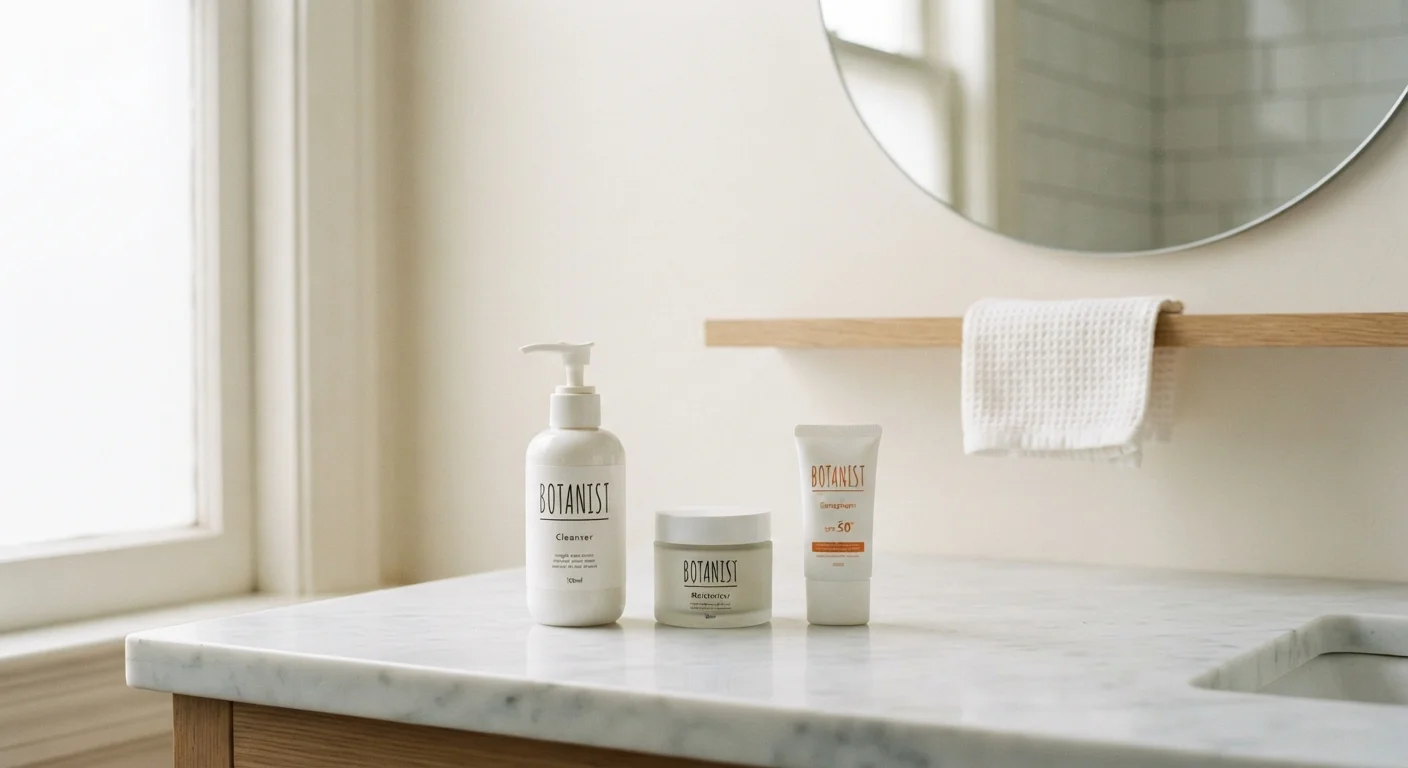
A minimalist skincare routine is generally defined as one that covers the non-negotiable functions of skin care-cleansing, hydration, and sun protection-without layering on additional serums, toners, exfoliants, or specialty treatments. In practice, that typically means three products: a gentle cleanser, a moisturizer suited to your skin type, and a broad-spectrum SPF of at least 30 for daytime use.
Some people expand slightly to include one targeted active-a retinoid at night, for instance, or a vitamin C serum in the morning-while still keeping the overall count low. The defining principle is intentionality: every product earns its place, and nothing is added out of habit or marketing pressure.
For a broader framework on building sustainable daily habits around self-care, see our guide to building a daily wellness ritual for practical strategies that apply well beyond the bathroom shelf.
The Real Advantages of Paring Back
The case for minimalism in skincare is grounded in both dermatological reasoning and practical reality.
Reduces risk of irritation and ingredient conflicts
Fewer products mean fewer potential irritants, fragrances, and actives competing on the skin's surface. This is particularly relevant for sensitive or reactive skin types, where overloading the routine is a common trigger for flare-ups.
Easier to identify what's working or causing reactions
With a small product count, you can isolate variables quickly. If a new product causes a reaction or a positive change, you'll know exactly what to credit or remove.
Supports consistent habit formation
A short, simple routine is easier to follow every day without skipping. Dermatologists broadly agree that consistency with basic steps outperforms sporadic use of a complex protocol.
Protects and supports the skin's natural barrier
Over-cleansing and over-exfoliating are leading causes of compromised skin barrier function. A stripped-back approach naturally avoids the most common forms of mechanical and chemical over-treatment.
Lower cost and less product waste
Maintaining three to four products is significantly less expensive than a multi-step regimen, and products are less likely to expire unused on the shelf.
One of the strongest arguments is the barrier-health argument. Many common skincare complaints-redness, breakouts, flaking, sensitivity-are caused or worsened by product overload rather than product deficiency. Stripping back reduces the number of potential irritants, fragrances, and preservatives your skin encounters daily, giving the skin's natural barrier a better chance to function well.
Minimalism also makes cause-and-effect far easier to read. If you're applying eight products and develop a reaction, tracing the culprit is genuinely difficult. With three or four products, the diagnostic process is straightforward. This connects directly to a point worth emphasizing: product layering and sequencing errors become a non-issue when there's very little to sequence.
~60%
Adults with self-reported sensitive skin
Studies across multiple countries consistently find that around 60% of adults describe their skin as sensitive, suggesting that a low-irritant, minimal approach has broad relevance.
3-4
Products in a clinically recommended basic routine
Dermatologists commonly cite a cleanser, moisturizer, and broad-spectrum SPF 30+ as the evidence-backed minimum for daily skin health maintenance.
Where a Stripped-Back Routine Falls Short
Minimalism is not a universal solution, and being clear-eyed about its limitations matters.
May not adequately address active skin concerns
Conditions like acne, hyperpigmentation, or rosacea typically benefit from targeted active ingredients. A basic cleanser-moisturizer-SPF combination lacks the specificity needed to produce meaningful improvements in these areas.
Misses the benefit of AM/PM differentiation
Skin physiology changes across the day; repair processes peak at night, while daytime calls for antioxidant and UV defense. A uniform minimal routine may not leverage these natural cycles effectively.
Can be misread as 'do the bare minimum' rather than 'do what's needed'
The minimalist label risks discouraging people from adding ingredients that are genuinely warranted, leading to under-treatment of addressable concerns in the name of simplicity.
Not always sufficient as skin changes with age or season
Skin's needs shift with hormonal changes, seasonal climate variation, and aging. A fixed minimal routine may become inadequate without periodic reassessment and adjustment.
The core limitation is specificity. Skin concerns like post-inflammatory hyperpigmentation, active acne, rosacea, or significant texture changes often require targeted ingredients-niacinamide, azelaic acid, prescription retinoids, or alpha hydroxy acids-to see meaningful improvement. A cleanser-moisturizer-SPF trio is unlikely to move the needle on these without at least one well-chosen addition.
There's also a timing dimension that minimalism can overlook. As dermatologists frequently note, the skin has distinct needs across the day. A routine that doesn't differentiate between morning and evening may miss the opportunity to use repair-oriented ingredients at night when skin cell turnover peaks. For a deeper look at this, our article on morning vs. evening skincare needs explains the logic behind timing-specific steps.
Minimalism Doesn't Mean Skipping SPF
Sunscreen is the single most evidence-supported skincare step for preventing photoaging and reducing skin cancer risk. Even the most stripped-back routine should include a broad-spectrum SPF 30 or higher every morning, regardless of how few other products are used. Omitting it in the name of minimalism works against the core purpose of the approach.
How to Decide If It's Right for You
The honest answer is that minimalism works best when your skin doesn't have active, specific concerns demanding targeted intervention. If your skin is generally balanced, not prone to breakouts, and your main goal is maintenance and sun protection, three products may genuinely be all you need-and adding more could work against you.
On the other hand, if you're working through a concern that has a well-established ingredient-based solution, excluding that ingredient in the name of minimalism isn't minimalism-it's under-treatment. The goal should be the minimum effective routine, not the smallest possible number of products regardless of outcome.
Whatever approach you choose, consistency is the variable that matters most. An erratic ten-step routine will generally underperform a faithfully maintained three-step one. For those new to structured self-care altogether, our introduction to daily self-care offers a grounded starting point without overwhelming complexity.
This article is for general informational purposes only and does not constitute medical or dermatological advice. If you have persistent skin concerns or conditions, consult a qualified dermatologist or healthcare professional.