
Why Cleanser Chemistry Matters
Cleansing is the foundation of any skincare routine, yet it is also one of the most misunderstood steps. The goal is not simply to create lather or rinse away visible dirt - it is to remove the specific mix of oil-soluble debris (sebum, sunscreen, pollution particles) and water-soluble residue (sweat, some makeup) without compromising the skin's protective barrier. How well any cleanser achieves that balance depends entirely on its chemistry. Understanding three distinct mechanisms - lipid dissolution, micelle action, and alkaline saponification - gives you a practical framework for choosing the right tool for your skin on any given day.
It is worth noting that skin surface pH naturally sits between roughly 4.5 and 5.5, a mildly acidic range that supports the acid mantle: a thin, protective film produced by sebaceous and sweat glands. Anything that significantly disrupts this pH can impair the barrier, increase transepidermal water loss, and alter the microbiome. Cleanser choice plays a direct role in maintaining or destabilising this environment.
Cleansing Oils: Lipid-to-Lipid Science
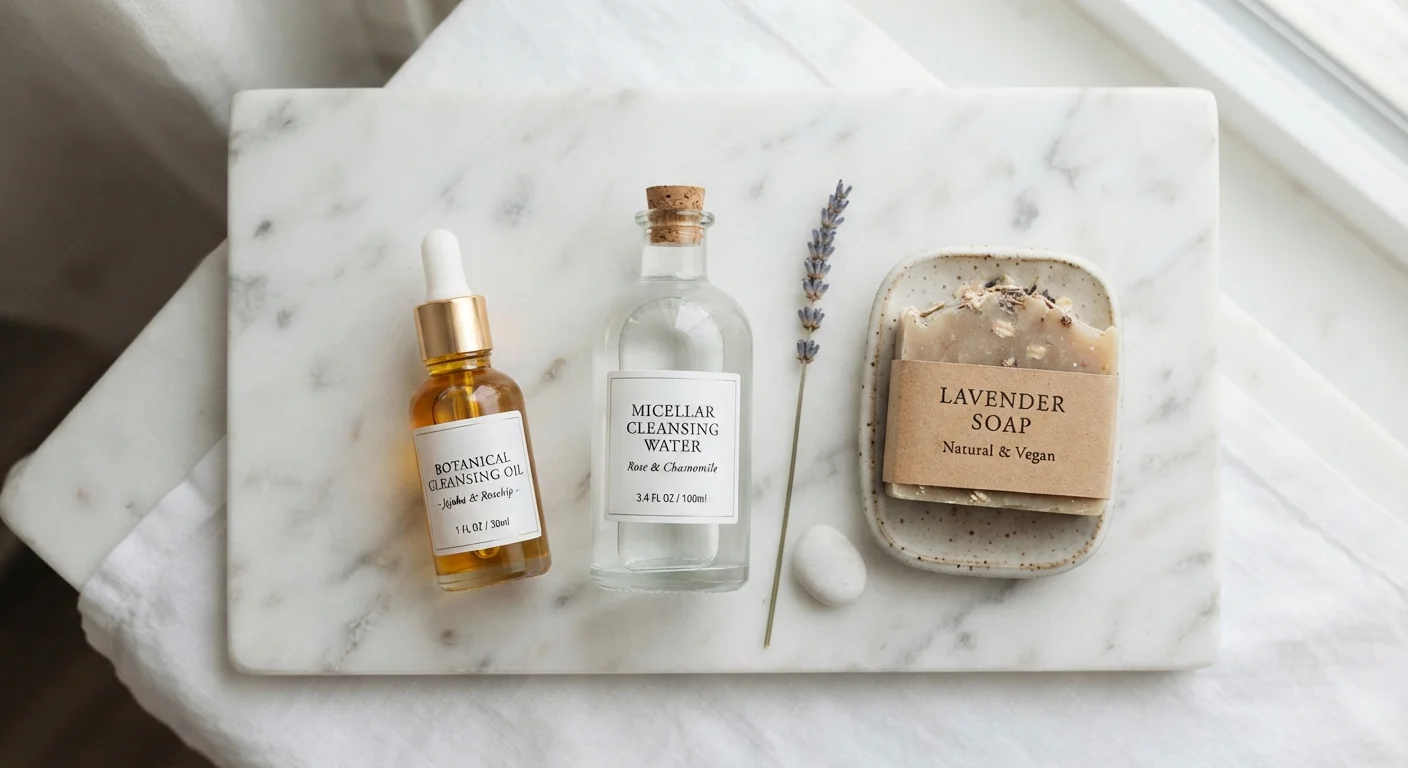
Cleansing oils work on the principle that like dissolves like. Applied to dry skin before water, an oil-based cleanser binds with oil-soluble substances - sebum, mineral-based SPF, silicone-heavy makeup, and waterproof formulas - and allows them to be emulsified and rinsed away when water is introduced. This mechanism is effective precisely because water alone cannot penetrate lipid-heavy residue.
Most formulated cleansing oils contain emulsifying agents that help them disperse on contact with water rather than leaving a greasy film. Lighter botanical oils such as jojoba (technically a wax ester) and oils high in linoleic acid are commonly used because they are structurally closer to human sebum and are less likely to clog pores for most skin types.
The Double-Cleanse Protocol Explained
Double cleansing involves applying a cleansing oil first to dry skin, massaging gently to dissolve oil-soluble debris, then emulsifying with water and rinsing. A gentle, pH-balanced water-based cleanser is applied second to remove any remaining residue. This sequence is particularly useful for those wearing SPF or makeup daily. It is not necessary for everyone - those with very dry or sensitised skin may find a single gentle cleanse sufficient on low-makeup days.
Crucially, cleansing oils do not strip the skin's natural lipids as aggressively as surfactant-heavy cleansers can. Dermatologists frequently recommend them as the first step in a double-cleanse protocol - particularly for those wearing SPF or long-wear cosmetics - followed by a gentle, pH-appropriate water-based cleanser to remove any remaining residue. This two-step approach is well-supported for maintaining barrier integrity while achieving thorough cleansing.
Micellar Water: Surfactant Science Without the Rinse
Micellar water is a water-based solution containing low concentrations of surfactant molecules arranged into structures called micelles - tiny spherical clusters with a water-attracting outer shell and an oil-attracting core. When a saturated cotton pad is pressed against the skin, the oil-core of each micelle traps makeup, light SPF residue, and surface impurities, while the water-attracting shell allows the whole complex to be lifted away.
Because micellar formulas typically use very mild, low-irritancy surfactants (such as poloxamers or mild non-ionic surfactants), they generally maintain a skin-compatible pH and are among the gentler cleansing options available. This makes them particularly suitable for sensitive, rosacea-prone, or eczema-adjacent skin - populations for whom mechanical friction and harsh surfactants are known aggravators.
The trade-off is thoroughness. Micellar water is excellent for light makeup, daily grime, and maintaining skin on low-effort evenings, but most formulators and dermatologists acknowledge it is not designed to fully dissolve heavy, waterproof, or silicone-based cosmetics. Relying on it alone after a high-SPF day may leave residue that accumulates over time. For a deeper understanding of how actives interact with a freshly cleansed face, see our breakdown of retinol, AHAs, and vitamin C.
Traditional Soap: Effective, But pH Comes at a Cost
Conventional bar and liquid soaps work through saponification - the chemical reaction of fats or oils with a strong alkali (historically lye, or sodium/potassium hydroxide) to produce soap salts, which are effective anionic surfactants. These surfactants reduce surface tension, emulsify grease, and carry debris away with water. For hand-washing or body cleansing of non-reactive skin, this is an efficient and economical mechanism.
The critical concern for facial use is pH. Traditional soaps typically produce solutions with a pH between 9 and 11 - significantly above the skin's natural acidic range. Repeated exposure to high-pH cleansers has been associated in dermatological literature with disruption of the acid mantle, increased transepidermal water loss, and a shift in skin microbiome composition. For individuals with dry, sensitive, or barrier-compromised skin, this can manifest as tightness, flakiness, or irritation after washing.
| Cleansing Oil | Micellar Water | Traditional Soap | |
|---|---|---|---|
| Primary mechanism | Lipid dissolution (like-dissolves-like) | Micelle-based surfactant lifting | Alkaline saponification |
| Typical skin pH impact | Minimal disruption | Minimal disruption | Raises skin pH significantly |
| Makeup/SPF removal | Excellent, especially heavy/waterproof | Moderate - best for light makeup | Moderate for surface grime |
| Barrier friendliness | High - preserves lipid layer | High - mild surfactants | Lower - strips acid mantle |
| Requires rinsing | Yes - emulsifies with water | No - removed with cotton pad | Yes - lather rinses off |
| Best suited for | Oily, combination, heavy SPF users | Sensitive, reactive, minimal makeup | Body use; normal non-reactive skin |
| Common concern | Incomplete rinse may feel heavy | Not thorough enough alone for heavy makeup | High pH can irritate sensitive skin |
Syndets (synthetic detergent bars) are a formulated alternative that mimic the lather and convenience of bar soap while maintaining a near-skin-neutral pH, often between 5 and 7. These represent a meaningful step forward for those who prefer bar-format cleansing but want to minimise pH-related disruption. Regardless of which cleanser you choose, following up with appropriate hydration is important - see our guide to a full-body moisturising routine built around skin type for practical next steps.
This article is for informational purposes only and does not constitute medical or dermatological advice. If you have a skin condition or concern, consult a qualified dermatologist or healthcare professional.