
Why Your Brain Prefers Routines
The brain is fundamentally an efficiency machine. Faced with thousands of decisions daily, it actively looks for patterns it can automate. When a behaviour is repeated consistently in a stable context, the brain begins to encode it as a chunk - a single unit of activity that can be triggered and run with minimal cognitive effort. This is the biological basis of the habit loop.
Neuroscientist Ann Graybiel's research at MIT demonstrated that as behaviours become habitual, activity shifts from deliberative regions of the brain to the basal ganglia, which handles procedural and automatic responses. The implication for self-care is significant: routines that are well-established require far less mental energy to maintain than those that depend on fresh motivation each day.
This is also why the early days of any new self-care practice feel effortful. The loop hasn't formed yet. What feels like a discipline problem is often just an incomplete neurological pattern. Understanding this removes a great deal of unnecessary self-blame and redirects focus toward the actual levers that matter. See what distinguishes wellness rituals from habits for more on why this distinction matters.
Breaking Down the Three Components
Each habit loop has three components, and understanding how each one functions in a self-care context makes it far easier to build routines that stick.
The Cue
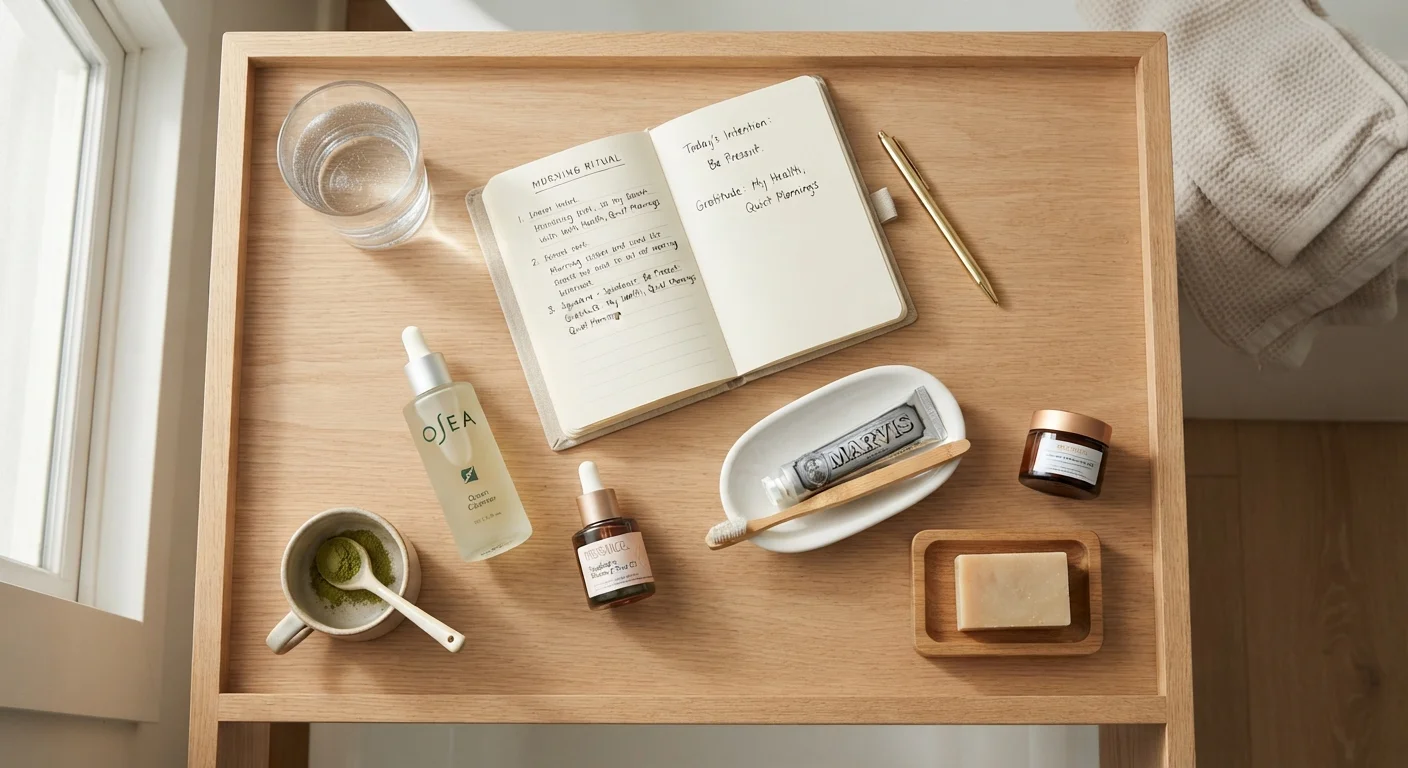
The cue is the trigger that initiates the behaviour. It can be a time of day, a location, an emotional state, a preceding action, or even a sensory signal like the smell of a particular product. For self-care habits, anchoring to a consistent cue is often the most important design decision. A morning skincare routine that begins immediately after a shower has a reliable, daily cue - one that doesn't depend on remembering or feeling motivated.
The Routine
The routine is the behaviour itself - the sequence of actions that follow the cue. One key insight from habit research is that simpler routines automate faster. An elaborate ten-step process is harder to encode than a focused three-step one. Starting with a minimal, repeatable sequence and expanding it gradually is more effective than trying to overhaul everything at once. Building a daily wellness ritual from scratch applies exactly this principle.
The Reward
The reward is what signals to the brain that the loop was worth completing. For the loop to strengthen, the reward must be felt promptly - delayed gratification is a poor teacher for the basal ganglia. This is why pairing a new behaviour with an immediate sensory or emotional payoff is so effective. The cooling sensation of a well-formulated toner, a moment of quiet, or a short body-scan meditation after exercise all function as near-immediate rewards that reinforce the preceding routine.
Make the Reward Immediate and Sensory
When designing a new self-care habit, choose a reward that can be felt within seconds of completing the routine. The scent of a product you genuinely enjoy, a moment of silence, or even a visual cue like a clean, organised counter all activate the reward signal quickly. The brain reinforces what it can feel right away - not what it knows is good for it in the abstract.
Habit Stacking and the Cue You Already Have
One of the most practical tools to emerge from habit loop research is habit stacking - attaching a new behaviour to an existing, reliable one. The established habit acts as a ready-made cue, eliminating the need to build trigger recognition from scratch. For self-care, this might look like: applying SPF immediately after moisturiser (already a habit), or doing two minutes of breathwork immediately after making morning coffee.
The specificity matters. "I will do X immediately after Y" is a far stronger implementation intention than "I will do X in the morning." Vague timing means vague cues, which means the loop is slow to form. The more precisely you link a new behaviour to a concrete existing one, the faster the pattern encodes.
66 days
Median time to habit automaticity
A 2010 study in the European Journal of Social Psychology (Lally et al.) tracked 96 participants forming new habits, finding a range of 18-254 days with a median around 66 days.
40%
Daily behaviours driven by habit
Research published in Psychological Science estimates that roughly 40% of people's daily actions are habitual rather than deliberate decisions.
It's also worth noting that habit stacking works best when the anchor habit and the new behaviour occur in the same physical context. Routines are partly location-dependent, which is why a skincare habit built around the bathroom sink is easier to maintain than one that requires moving to a different room or retrieving separate equipment.
When Habit Loops Break - and How to Rebuild
Even well-established loops can be disrupted by changes in context: travel, illness, a shift in schedule, or a period of high stress. When the cue disappears or changes, the routine loses its trigger and the loop stalls. This is one of the primary reasons self-care routines collapse - not a character flaw, but a disrupted environmental cue.
Rebuilding after a break requires returning to the cue, not trying to force the routine through sheer effort. Re-anchoring the behaviour to a consistent trigger, and keeping the routine minimal while the loop re-establishes, is more effective than trying to return immediately to a full sequence. Why self-care routines collapse after two weeks explores this pattern in more depth.
Context Changes Reset Habit Loops
Moving home, starting a new job, or returning from a long trip are periods when many habits - including self-care routines - naturally destabilise. Research on habit discontinuity suggests these transitions can actually be useful windows for forming new habits, since old automatic patterns are also disrupted. Intentionally anchoring new behaviours to new-context cues during these periods can accelerate loop formation.
For those building core skincare habits or any aspect of physical health routines, the habit loop framework applies equally. The biology doesn't change based on the domain. What changes is how you design the cue and what you choose as the reward. Designing both deliberately - rather than leaving them to chance - is the most reliable path to routines that last. See also why consistency outperforms intensity for the long-term view.
This article is for informational purposes only and does not constitute medical or psychological advice. For concerns about mental health, behavioural patterns, or physical wellbeing, consult a qualified healthcare professional.