
How Each Borrowing Tool Works
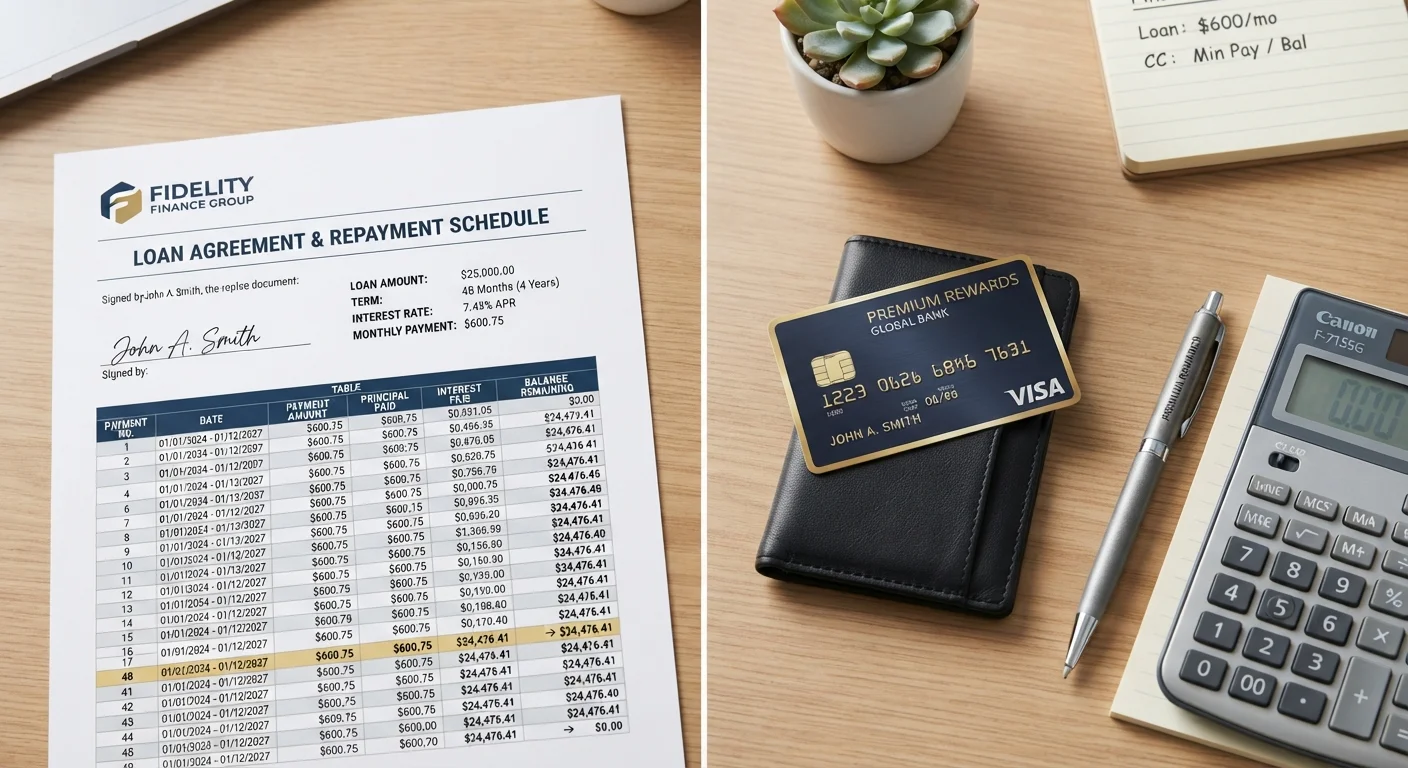
A personal loan is an installment product: a lender advances you a lump sum, and you repay it in equal monthly payments over a set term - typically 24 to 84 months - at a fixed annual percentage rate (APR). Once repaid, the account closes. Because the rate and payment are locked in from the start, budgeting is straightforward.
A credit card is a revolving line of credit. You borrow up to an approved limit, make at least a minimum monthly payment, and can continue borrowing against available capacity as you repay. If you clear the balance before the grace period ends, no interest is charged. Carry a balance, and interest accrues at the card's APR - which is typically variable and can change with market conditions.
Both products are generally unsecured, meaning no collateral is required. For more context on how unsecured debt differs from secured borrowing, see Secured vs. Unsecured Debt: How the Difference Shapes Your Options.
Comparing the Costs
| Personal Loan | Credit Card | |
|---|---|---|
| Interest Rate Type | Fixed APR | Variable APR (typically) |
| Typical APR Range | 7%-36% depending on credit | 15%-30%+ depending on credit |
| Repayment Structure | Fixed monthly installments | Minimum payment; revolving balance |
| Credit Utilization Impact | Not counted in utilization ratio | Directly affects utilization ratio |
| Access to Funds | Lump sum, one time | Revolving line, reusable |
| Best Use Case | Large planned expenses | Short-term or recurring purchases |
| Origination Fees | Often 1%-8% of loan amount | Generally none |
| Hard Credit Inquiry | Yes, at application | Yes, at application |
Interest is the dominant cost for most borrowers. Personal loan APRs are typically fixed at origination and depend heavily on credit score, income, and debt-to-income ratio. Credit card APRs are generally variable and, even for well-qualified applicants, tend to run higher than personal loan rates for equivalent credit profiles.
~21%
Average credit card APR (2024)
According to Federal Reserve data, average credit card interest rates reached historic highs in recent years, underscoring the cost of carrying a revolving balance.
~12%
Average personal loan APR for well-qualified borrowers
Borrowers with strong credit profiles have generally accessed personal loan rates well below average credit card rates, based on industry lending data.
Beyond interest, personal loans sometimes carry origination fees - a one-time charge deducted from the loan proceeds or added to the balance. Credit cards rarely impose setup fees, though they may charge annual fees, late fees, or foreign transaction fees. When comparing total borrowing cost, factor in all fees, not just the advertised rate.
Familiarity with core terminology - APR, principal, minimum payment - helps you evaluate offers accurately. The Key Terms Every Borrower Should Understand glossary covers the concepts most commonly encountered when reviewing loan and card disclosures.
Impact on Your Credit Profile
Both products trigger a hard inquiry when you formally apply, which can temporarily lower your credit score by a few points. Beyond the application stage, however, each affects your credit profile differently.
Credit cards directly influence your credit utilization ratio - the percentage of your revolving credit limit currently in use. High utilization (generally above 30%) tends to weigh negatively on credit scores. A large credit card balance relative to your limit can suppress your score even if you make every payment on time. Personal loans, as installment accounts, do not factor into utilization ratios in the same way.
On the positive side, consistent on-time payments on either product build payment history, the single largest factor in most credit scoring models. A well-managed credit card - used regularly and paid in full - can be an efficient credit-building tool. If errors on your credit report are affecting your score before you apply, the process is outlined in Disputing an Error on Your Credit Report.
Check for Prequalification Options First
Many lenders and card issuers allow you to check your likely rate or approval odds through a soft credit inquiry, which does not affect your credit score. Prequalifying before formally applying helps you compare realistic offers without the risk of multiple hard inquiries. Review your credit profile beforehand - see our pre-application checklist for a useful preparation framework.
When a Personal Loan Makes More Sense
A personal loan is generally the stronger fit when:
- You need a specific, large sum for a defined purpose - home improvement, medical expenses, or a major purchase - and want a clear payoff date.
- You want to lock in a rate and avoid exposure to variable rate fluctuations.
- You are consolidating higher-interest debt into a single, structured payment. For a deeper look at that strategy, see Debt Consolidation: What It Is, How It Works, and When It Makes Sense.
- You want predictable monthly payments that fit easily into a fixed budget.
Carrying a Balance Is Costly
Credit cards are designed for convenience, but carrying a balance from month to month means interest compounds quickly at rates that are often far higher than personal loan rates. A borrower who makes only minimum payments on a large balance can end up paying substantially more than the original purchase price over time. If you cannot realistically pay off a charge within a billing cycle or two, a personal loan with a fixed repayment schedule may be the lower-cost path.
When a Credit Card Makes More Sense
A credit card tends to be the practical choice when:
- Expenses are recurring or unpredictable, and you need flexible access to funds rather than a lump sum.
- You have the discipline to pay the balance in full each month, effectively borrowing at zero interest during the grace period.
- You want to benefit from purchase protections, rewards programs, or travel benefits that credit cards often bundle in - though the value of these features depends entirely on how you use the card and whether you carry a balance.
- The amount needed is relatively small and short-term in nature.
Once you have chosen a borrowing path, thinking ahead about repayment strategy is equally important. The Debt Snowball vs. Debt Avalanche comparison covers two structured approaches to paying down debt systematically.
This article is for general informational and educational purposes only and does not constitute personalised financial, legal, or tax advice. Borrowing decisions depend on individual circumstances. Consult a licensed financial adviser or credit counsellor before taking on new debt.