

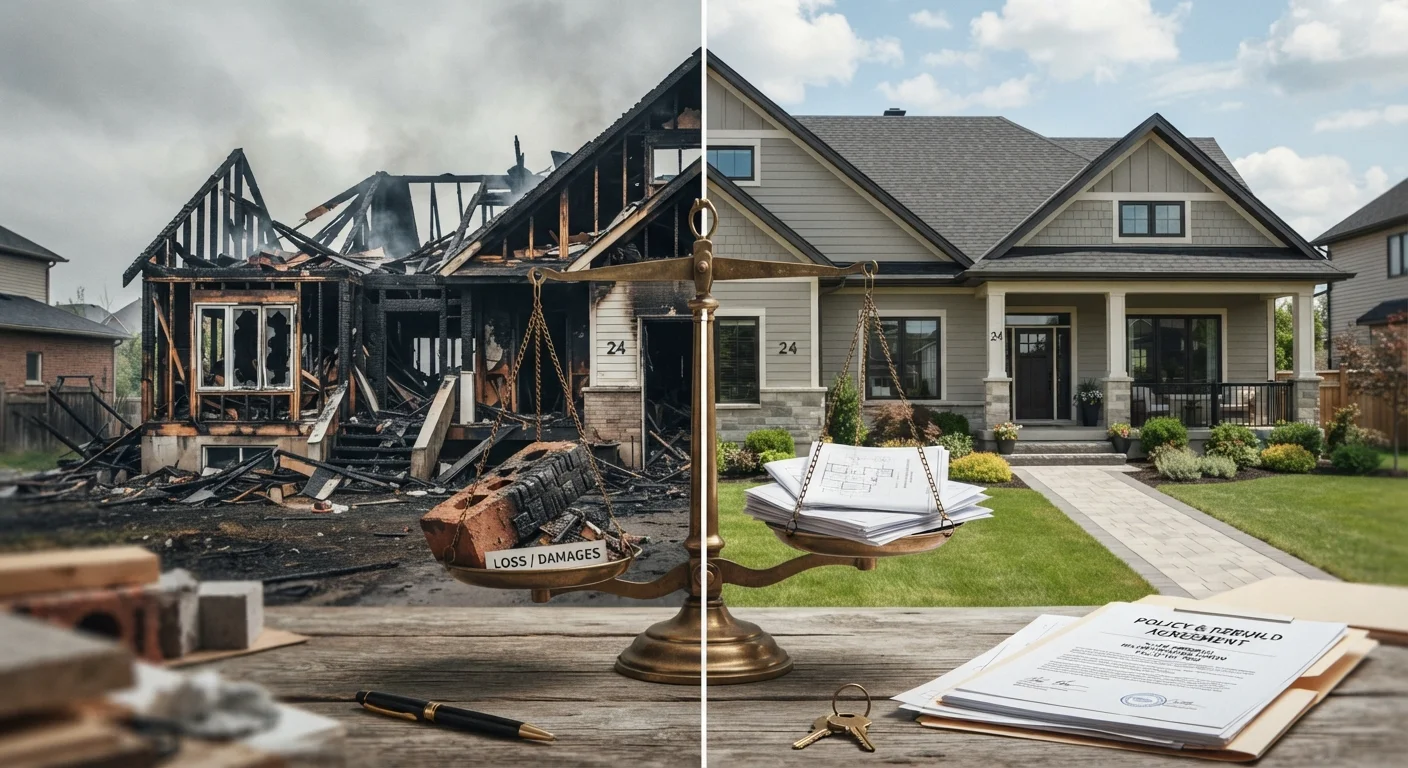
What These Two Valuation Methods Actually Mean
When a covered loss occurs - a fire, a windstorm, water damage - your insurer doesn't simply hand over an unlimited check. The amount you receive is governed by how your policy values the damaged property. Two dominant methods exist in U.S. property insurance: Actual Cash Value (ACV) and Replacement Cost Value (RCV). Understanding the difference is essential to knowing what you actually own.
Actual Cash Value is broadly defined as the replacement cost of the damaged item minus depreciation. Depreciation accounts for the age, wear, and condition of the property at the time of the loss. If your ten-year-old roof is destroyed in a hailstorm, an ACV policy won't pay what a new roof costs - it pays what that ten-year-old roof was worth at the moment it was damaged.
Replacement Cost Value does not deduct for depreciation. Under an RCV policy, the insurer is obligated to pay what it costs to repair or replace the damaged property with new materials or items of like kind and quality, up to your policy limit. That same hail-damaged roof would be reimbursed at the current cost to install a comparable new roof.
| Criterion | Actual Cash Value (ACV) | Replacement Cost Value (RCV) |
|---|---|---|
| How payout is calculated | Replacement cost minus depreciation | Full cost to repair or replace with new |
| Depreciation deducted | Yes | No |
| Typical premium level | Lower | Higher |
| Out-of-pocket gap after loss | Potentially significant | Minimal (up to policy limit) |
| Best suited for | Budget-conscious; adequate reserves | Maximum post-loss financial protection |
| Impact of property age | High - older property = larger deduction | Low - age does not reduce payout |
| Applies to | Structure and/or personal property | Structure and/or personal property |
This distinction is not trivial. On a major structural loss, the gap between an ACV and an RCV settlement can reach tens of thousands of dollars. As noted in our broader overview of major insurance types and what they cover, homeowners insurance in particular requires careful attention to coverage limits and valuation terms - not just the premium price.
How Depreciation Is Calculated - and Why It Matters
Depreciation under an ACV policy is not a fixed, universal formula. Insurers typically consider an item's expected useful life and its age at the time of loss. A roof with a 20-year expected lifespan that is 10 years old at the time of damage may be depreciated by 50%. Applied to a $20,000 replacement cost, that yields a $10,000 ACV payout - leaving the policyholder to cover the remaining $10,000 out of pocket.
Depreciation calculations can apply not only to structural elements like roofing and HVAC systems, but also to personal property under a renters or homeowners policy - furniture, electronics, appliances, and clothing can all carry significant depreciation at the time of a claim.
What 'Recoverable Depreciation' Means
Some policies include a recoverable depreciation provision, allowing insurers to withhold the depreciation amount initially and release it after the policyholder completes and documents repairs. This is not the same as a standard ACV policy and typically requires additional steps and documentation from the insured. Review your policy language or speak with your agent to understand whether this provision applies to your coverage.
Some ACV policies offer an optional endorsement called a recoverable depreciation provision, sometimes embedded in RCV upgrades. Under this structure, the insurer initially pays the ACV, and once the policyholder completes repairs and submits documentation, the withheld depreciation amount is released. This is distinct from a standard ACV policy, and the specific terms vary by insurer and policy.
Because depreciation methodology varies across insurers, it's worth reviewing how your policy defines and calculates it - not just whether your policy is labeled ACV or RCV. As our article on why a low premium doesn't always mean a good deal explains, policy structure details like these often matter far more than the monthly cost alone.
Premium Costs, Trade-Offs, and When to Reassess
RCV policies typically cost more than ACV policies because insurers carry greater financial exposure. The premium difference can be meaningful, though it varies by property type, location, age of the home, and individual insurer pricing. For some policyholders - particularly those with newer construction, newer contents, or limited financial reserves - the additional premium may be a sound trade-off for the reduced claim gap.
For others, especially those insuring older properties or maintaining substantial emergency savings, an ACV policy's lower premium might be a reasonable choice, with the understanding that any settlement will be reduced by depreciation. This is a general financial consideration, not a universal recommendation - individual circumstances vary significantly.
~50%
Potential depreciation on a mid-life roof under ACV
A roof with a 20-year lifespan that is 10 years old at time of loss may receive only half its replacement value under an ACV settlement, depending on insurer methodology.
Thousands
Dollar gap possible between ACV and RCV on a major claim
On significant structural losses such as roof replacement or HVAC damage, the difference between ACV and RCV payouts can reach five figures, based on typical depreciation schedules.
Your coverage choice should also be revisited when your life circumstances change. Major events - purchasing a new home, renovating an existing one, acquiring significant personal property, or facing changes in household income - can all shift whether ACV or RCV coverage is appropriate for your situation. Our guide to life events that should trigger an insurance review outlines the key moments to reassess your coverage.
If you are weighing the cost of coverage against maintaining larger personal reserves, the broader question of self-insuring versus buying coverage may also be relevant context for your decision.
This article is for general informational purposes only and does not constitute personalized insurance, financial, or legal advice. Coverage terms, definitions, and availability vary by insurer, policy, and state. Consult a licensed insurance agent or adviser to evaluate which coverage options are appropriate for your specific situation.