
What's Actually Inside Each Product
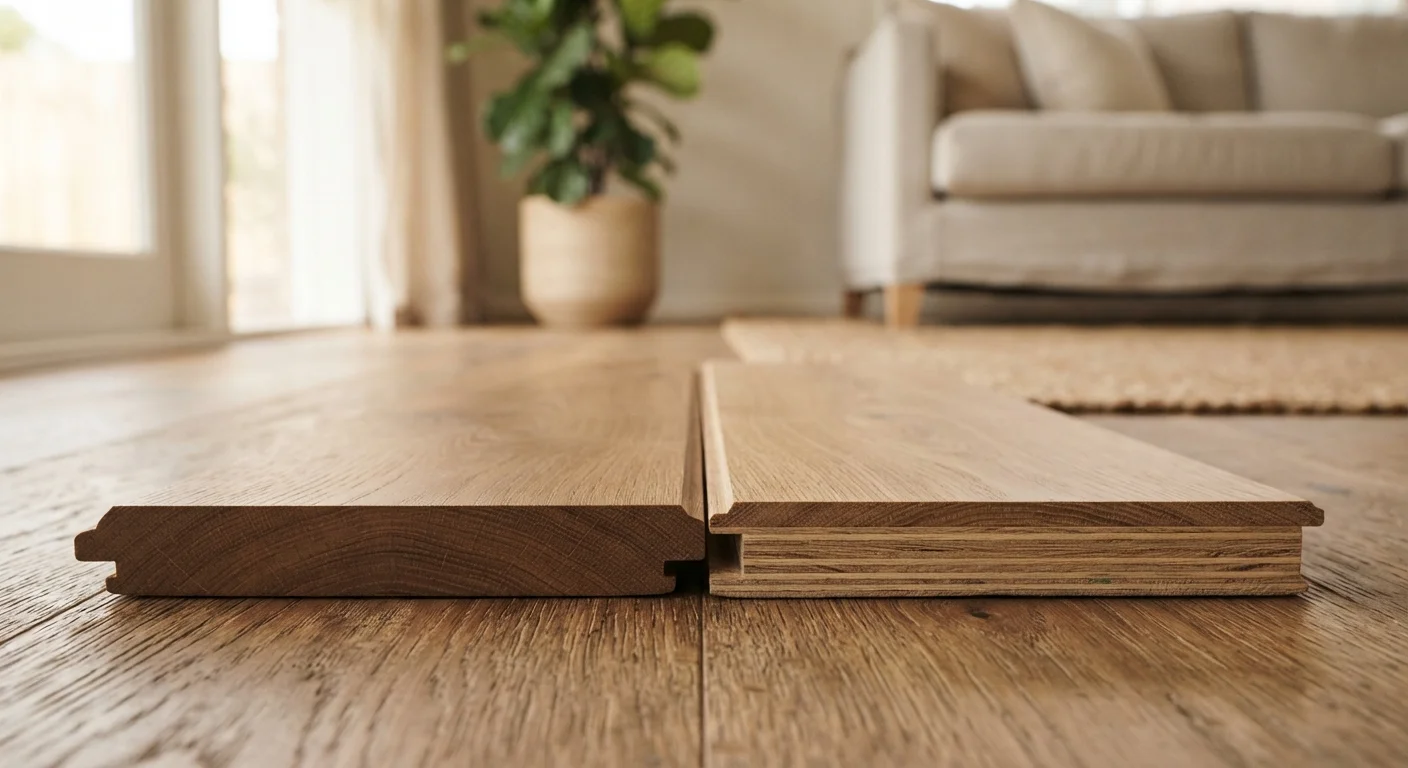
The most important difference between solid timber and engineered wood isn't visible from above - it's structural. Solid timber planks are cut from a single piece of hardwood throughout their entire thickness, typically ranging from ¾ inch to 5/16 inch. Every millimeter is the same species, grain, and material.
Engineered wood, by contrast, is a layered composite. A real hardwood veneer - often 2mm to 6mm thick - is bonded to a core of cross-directional plywood layers. This cross-grain construction is deliberate engineering: it counteracts wood's natural tendency to expand and contract across its grain when moisture levels shift.
This structural distinction explains nearly every behavioral difference between the two products. The label may say "real wood floors" on both boxes - because technically both are - but how they respond to your home's environment differs substantially.
| Criterion | Solid Timber | Engineered Wood |
|---|---|---|
| Core composition | 100% single-species hardwood | Hardwood veneer over cross-ply core |
| Dimensional stability | Lower - moves with humidity | Higher - engineered to resist movement |
| Compatible with underfloor heating | Generally not recommended | Yes, in most engineered products |
| Below-grade installation | Not suitable | Generally suitable |
| Installation methods | Nail- or staple-down only | Glue, nail, or float |
| Refinishing potential | Multiple times (3-7+) | Limited by veneer thickness (1-3) |
| Typical plank thickness | 18-20mm | 12-21mm (varies by construction) |
| Surface appearance | Natural hardwood grain | Natural hardwood grain (identical visually) |
How Each Responds to Moisture and Temperature
Wood moves. All species expand when humid and contract when dry, and that movement happens primarily across the grain - meaning plank width, not length, is what changes. In solid timber, this movement is unconstrained and cumulative across a floor's full width. In a wide room with seasonal humidity swings, solid timber can gap noticeably in winter and buckle slightly in summer if not properly acclimated and installed with adequate expansion gaps.
Engineered wood's cross-ply core dramatically reduces this movement. Because adjacent layers run perpendicular to each other, their expansion forces partially cancel out. This is why engineered wood is cleared for installation over radiant underfloor heating systems, while solid timber generally is not - the repeated heating cycles accelerate movement cycles that can cause cupping, cracking, or gapping in solid planks.
6-8mm
Typical veneer thickness for refinishable engineered wood
Industry guidance generally suggests a minimum 4mm veneer to allow even one light sand; thicker veneers of 6mm or more offer more refinishing cycles.
±3-5%
Acceptable indoor relative humidity range for wood floors
The National Wood Flooring Association recommends maintaining indoor RH between 35% and 55% year-round to minimize wood movement in both solid and engineered products.
100 years
Potential lifespan of solid hardwood floors
Historic homes across the US commonly retain original solid hardwood floors over a century old, provided they have been properly maintained and refinished.
Neither product is waterproof. Both will sustain damage from standing water or flooding. The distinction is in how each handles ambient humidity variation - engineered wood tolerates it better, but it still requires a dry, controlled environment for long-term performance.
Installation Methods and Subfloor Compatibility
Solid timber is almost exclusively installed using nail-down or staple-down methods into a wooden subfloor. It cannot be glued to concrete directly in most applications, and floating installation is rarely appropriate because the product's mass and movement require mechanical fixing.
Engineered wood offers more flexibility. Depending on the product's construction and thickness, it can be:
- Glued down directly to concrete slabs
- Nailed or stapled into a timber subfloor
- Floated over underlayment using click-lock or tongue-and-groove profiles
This makes engineered wood the practical choice for renovations where the subfloor type is variable or where a floating installation is preferable - such as over existing tile or when avoiding fasteners is important.
Check Local Building Codes Before Installing
Some jurisdictions require permits for flooring work that involves changes to the subfloor structure, or have specific requirements for adhesives used in below-grade applications. Always verify your local building department's requirements before beginning any flooring project, particularly in multi-family buildings where noise transmission standards may apply.
Both products require the flooring to acclimate to the room's temperature and humidity before installation - typically 48 to 72 hours on-site. Skipping this step is one of the most common causes of post-installation problems with both types.
Longevity, Refinishing, and What Happens When Things Go Wrong
Solid timber's primary long-term advantage is refinishability. Because the entire plank depth is hardwood, a floor can be sanded back and refinished - with new stain, sealer, or texture - anywhere from three to seven times over its life, depending on the original thickness and how aggressively each refinish removes material. This means a well-maintained solid timber floor genuinely can last a century.
Engineered wood can also be refinished, but only as many times as the veneer layer allows. A 2mm veneer may tolerate one light sand; a 6mm veneer could handle two or three. Once the veneer is sanded through, the floor cannot be refinished - it must be replaced. For most residential applications with reasonable traffic and proper care, this limitation is rarely encountered within the floor's expected service life.
For localized damage - deep gouges, pet stains, or water damage to individual boards - both products can have individual planks replaced, provided matching stock is available. This is easier with engineered click-lock systems than with nailed solid timber, where boards are interlocked and neighboring planks may need to be disturbed.