

How Ford Structures Its US Lineup
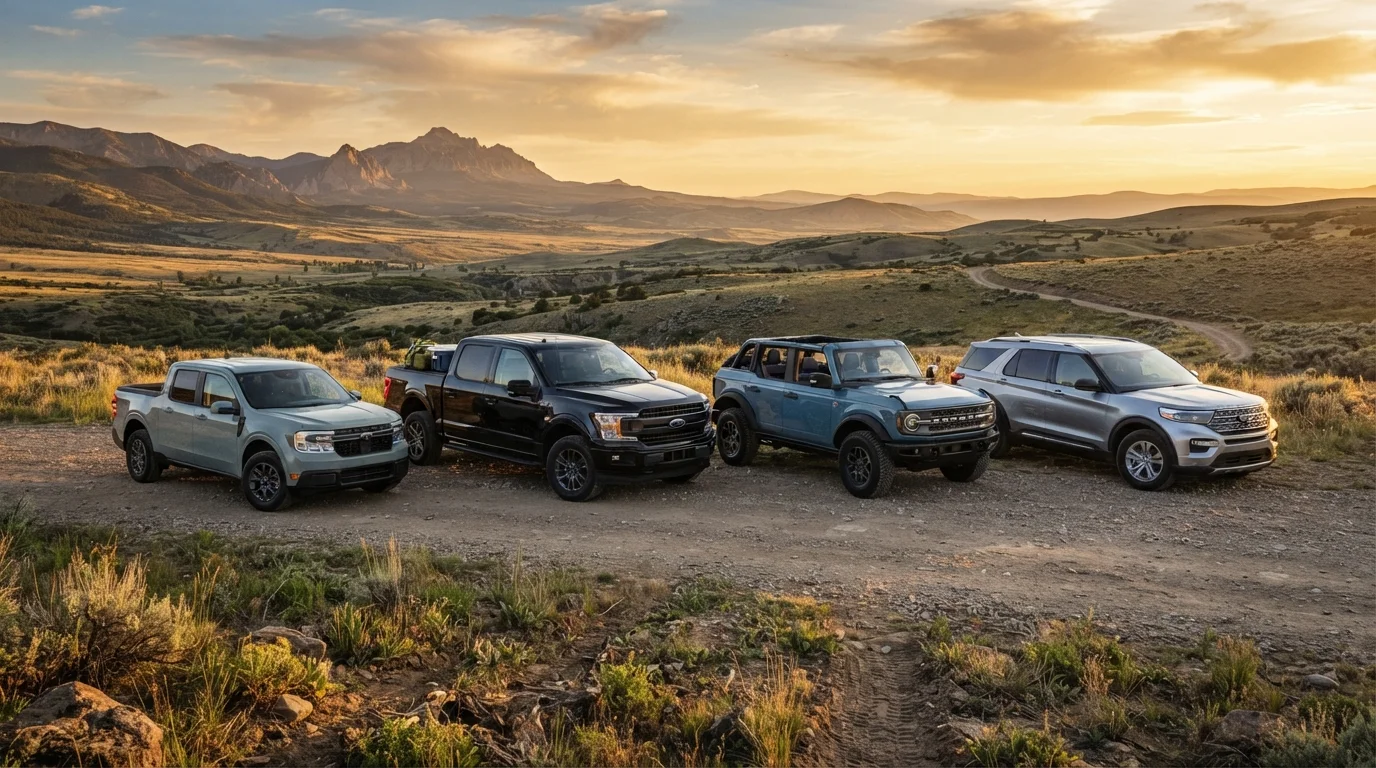
Ford's North American vehicle portfolio covers a wide range of segments - from compact crossovers and a small pickup to the iconic full-size F-Series. Understanding how each model is positioned helps consumers match their actual needs to the right vehicle class rather than relying on brand loyalty alone.
Ford has largely exited the traditional passenger car segment in the US (with the exception of the Mustang), pivoting its lineup toward trucks, SUVs, and crossovers - a shift that reflects broad consumer demand. For a broader understanding of how these vehicle categories are defined across the industry, see vehicle segments explained.
Trucks: The Maverick, Ranger, and F-Series
Ford's truck lineup is its commercial backbone, spanning three distinct size classes.
Maverick
The Maverick is Ford's compact pickup, introduced for the 2022 model year. It's built on a unibody platform (shared with crossovers rather than traditional body-on-frame architecture), which keeps curb weight and base pricing relatively accessible. Standard powertrain on base trims is a hybrid system; a turbocharged four-cylinder is offered on higher trims. The Maverick targets urban and suburban buyers who want truck utility in a smaller, more maneuverable package.
Ranger
The Ranger occupies the mid-size truck segment. It uses a body-on-frame construction and is aimed at buyers who need more towing and payload capacity than the Maverick offers but don't require a full-size truck. The Ranger competes in a segment that has grown considerably in the US over the past decade.
F-150 and the F-Series
The F-Series - anchored by the F-150 and extending through the heavy-duty F-250, F-350, and beyond - has been the best-selling vehicle in the United States for over four decades, according to industry sales data. The F-150 is offered in configurations ranging from work-oriented base trims to premium configurations, and includes the F-150 Lightning, an all-electric variant. Heavy-duty Super Duty models (F-250 and up) use a separate platform optimized for significantly higher towing and payload ratings.
Unibody
A vehicle construction method where the body and frame are integrated into a single structure. Common in cars and crossovers, it generally results in lighter weight and a smoother ride compared to body-on-frame designs.
Body-on-Frame
A construction approach where the vehicle body is mounted on a separate ladder-style frame. This design is common in full-size trucks and traditional SUVs and generally supports higher towing and payload capacities.
Plug-in Hybrid (PHEV)
A vehicle that combines a conventional combustion engine with an electric motor and a battery that can be recharged from an external power source. It can travel a limited distance on electricity alone before the combustion engine takes over.
Super Duty
Ford's heavy-duty truck designation, applied to F-250, F-350, and larger F-Series models. These trucks use a separate platform from the F-150 and are rated for significantly greater towing and payload capacity.
Model Year
The year designation assigned to a vehicle by the manufacturer, which often differs from the calendar year in which the vehicle goes on sale. See model year conventions explained for more detail.
SUVs and Crossovers: EcoSport to Expedition
Ford's SUV and crossover range is similarly tiered by size and intended use.
EcoSport and Escape
The EcoSport represented Ford's subcompact crossover entry, though its availability has been reduced in the US market. The Escape sits in the compact crossover class and has historically been one of Ford's higher-volume passenger vehicles. A plug-in hybrid variant is available in the Escape lineup.
Edge and Bronco Sport
The Edge is a mid-size, two-row crossover. The Bronco Sport - separate from the full Bronco - is a compact crossover with styling cues borrowed from the Bronco but built on a unibody platform better suited to everyday commuting than serious off-road use.
Explorer and Expedition
The three-row Explorer is one of Ford's most recognized nameplates, targeting families who need additional passenger capacity. The larger Expedition is a full-size, body-on-frame SUV sharing its platform with the F-150. It offers maximum passenger and cargo space, and competes with vehicles like the Chevrolet Suburban. For perspective on how Ford's product strategy compares historically to rivals, see Ford and Chevy's long competitive history.
The Bronco, Mustang, and Ford's Electric Models
Three nameplates in Ford's lineup carry particular cultural weight and deserve individual attention.
Bronco
The full-size Bronco, reintroduced after a long absence, is a body-on-frame SUV engineered with off-road capability as a primary design objective - featuring removable doors and roof panels, solid front and rear axle options on some trims, and dedicated trail management systems.
Mustang
The Mustang remains Ford's sole traditional performance car in the US market. Now in its seventh generation, it retains a rear-wheel-drive layout and is available as a coupe or convertible. The Mustang Mach-E - despite sharing the name - is a separate, fully electric crossover with no mechanical relationship to the Mustang coupe.
Electric Models
Beyond the F-150 Lightning and Mustang Mach-E, Ford has expanded its electric vehicle presence under its "Ford Pro" commercial division. For a broader look at how legacy automakers are navigating this transition, see how traditional brands are electrifying their lineups.
Ford's Lineup Evolves Regularly
Ford periodically adds, discontinues, or repositions models in response to market demand and regulatory requirements. The information here reflects the general structure of Ford's US lineup as it has been constituted in recent model years, but specific model availability may change. Always verify current offerings directly with Ford or an authorized dealer before making any purchasing decision.