

Why Brand Origins Still Matter to Today's Car Buyers
The car brand on a vehicle's badge carries more than a logo - it carries a philosophy, a manufacturing tradition, and a set of values forged over decades. For American consumers choosing among dozens of options, understanding where a brand came from can illuminate why its vehicles behave and hold up the way they do.
Founding decisions - whether to prioritize volume over craftsmanship, reliability over power, or affordability over prestige - echo through model lineups for generations. The stories below trace the origins of the brands most commonly seen on American roads, from Detroit-born giants to Japanese manufacturers that reshaped the global standard. For a deeper look at how national automotive traditions shape the cars themselves, see our piece on how country of origin shapes car design philosophy.
Ford Motor Company (1903): The Brand That Built the Modern Factory
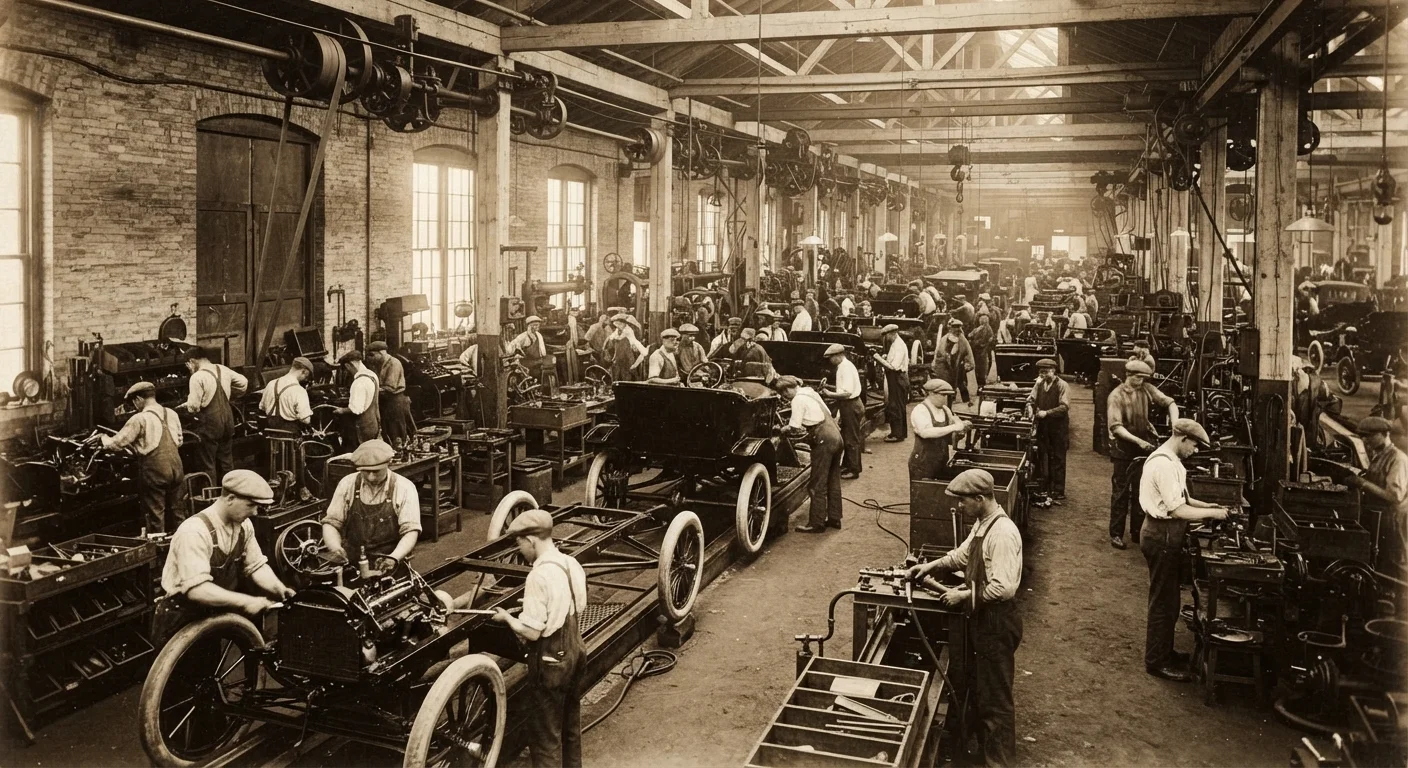
Henry Ford did not invent the automobile, but he fundamentally changed who could own one. Founded in Detroit on June 16, 1903, Ford Motor Company launched with a straightforward goal: build a reliable car that ordinary Americans could afford. The Model T, introduced in 1908, delivered on that promise - and the moving assembly line Ford implemented at Highland Park in 1913 made mass production an industrial blueprint copied worldwide.
Ford's founding ethos was rooted in efficiency and accessibility. The company reduced the Model T's price repeatedly as production volumes rose, demonstrating that scale could drive affordability. That logic - build at volume, reduce cost, expand the market - remains visible in Ford's approach to high-volume models today. For a current look at how Ford structures its lineup around that philosophy, see Ford's model lineup explained.
Ford's moving assembly line turned car ownership from a luxury into an everyday American reality.
General Motors (1908): A Corporation Built from Acquisitions
General Motors was not born from a single inventor's vision but from a deliberate consolidation strategy. Founded in 1908 by William C. Durant, GM grew by acquiring existing automakers - Buick, Oldsmobile, Cadillac, and eventually Chevrolet - under one corporate roof. The multi-brand structure that defines GM to this day traces directly to those early acquisitions.
Durant's idea was to offer vehicles at every price point, letting consumers move up the GM ladder as their incomes grew. Alfred Sloan, who later led the company through the 1920s and 1930s, formalized this into a disciplined brand hierarchy. Understanding GM's origins explains why it has historically maintained distinct brand identities rather than collapsing into a single nameplate.
GM was built on acquisition from the start, a strategy that shaped its multi-brand structure for over a century.
Chevrolet (1911): Born from a Boardroom Rivalry
Chevrolet's founding is inseparable from a power struggle within General Motors itself. After Durant lost control of GM in 1910, he partnered with Swiss-American racing driver Louis Chevrolet to create a new car company in 1911. The venture succeeded well enough that Durant used Chevrolet stock to regain control of GM by 1916, eventually folding Chevrolet into the larger corporation.
That combative origin left Chevrolet positioned as GM's volume brand - the affordable, broad-market counterweight to Ford. The rivalry between the two brands that followed is one of the longest-running in American automotive history. Our article on a century of Chevy vs. Ford competition traces how that contest evolved across decades.
Chevrolet was created as a strategic tool in a boardroom power struggle - and became one of America's most recognized brands.
Toyota (1937): Precision Manufacturing as a Cultural Value
Toyota's automotive division was established in 1937 as a spinoff of the Toyoda Automatic Loom Works, a textile machinery company. The founding family - the Toyoda family, who changed the brand name's spelling for trademark and phonetic reasons - brought an industrial precision mindset from textile manufacturing into automobile production.
After significant damage to its facilities during World War II, Toyota rebuilt using a production philosophy now known as the Toyota Production System (TPS). Built around eliminating waste, continuous improvement (kaizen), and just-in-time inventory, TPS became a global manufacturing benchmark far beyond the auto industry. That disciplined foundation underlies Toyota's reputation for long-term reliability, which is examined in depth in our comparison of Toyota and Honda engineering philosophies.
Toyota's post-war production system became a global standard for manufacturing efficiency and quality control.
Honda (1948): From Motorcycles to a Global Automaker
Honda's path to automobiles began on two wheels. Soichiro Honda founded Honda Motor Co. in 1948, initially producing motorized bicycles to meet postwar Japan's demand for cheap, practical transportation. The motorcycle business funded engineering experimentation that eventually led to automobile production in 1963.
Honda entered the US market with small, fuel-efficient cars at a time when American automakers were focused on larger vehicles. The 1973 oil crisis shifted consumer priorities sharply toward economy cars, and Honda's timing proved fortuitous. The company built its US reputation on engineering independence - developing its own engines rather than relying on outside suppliers - and that tradition of in-house innovation has remained a defining trait. Honda's current standing among American drivers is covered in our overview of America's most popular car brands.
Honda's motorcycle origins instilled an engineering self-reliance that still defines how the company builds its vehicles.
Chrysler (1925): Engineering Ambition in a Crowded Market
Walter P. Chrysler founded the Chrysler Corporation in 1925 after reorganizing the struggling Maxwell Motor Company. A trained engineer rather than a businessman first, Chrysler differentiated his vehicles through technical features - high-compression engines and hydraulic brakes were notable early examples at a time when competitors offered simpler mechanicals.
Chrysler quickly became the third pillar of the US auto industry alongside Ford and GM, acquiring Dodge Brothers in 1928 and launching Plymouth the same year to compete directly in the mass-market segment. The brand's engineering-forward identity has carried through ownership changes and restructurings, and understanding that identity helps explain both its strengths and the challenges it has faced in periods when engineering alone was not enough to sustain market share.
Chrysler was founded by an engineer who used technical differentiation to carve out space in an already crowded market.
What These Histories Tell Us About the Road Ahead
Each of these brands navigated crises - economic downturns, wartime production shifts, fuel shortages, and now the transition to electrification - by drawing on the values embedded at their founding. Ford's emphasis on democratizing transportation is now reflected in its approach to electric trucks. Toyota's relentless focus on process discipline underpins its hybrid and fuel-cell programs. Honda's engineering independence continues to drive unconventional powertrain choices.
Research a Brand's Heritage Before You Buy
A brand's founding philosophy often predicts where it invests in research and development today. A manufacturer with deep roots in fuel-efficient engineering may approach electrification differently than one built on performance or volume. When researching a vehicle purchase, looking at a brand's long-term trajectory - not just current model-year specs - can provide useful context for evaluating reliability and long-term support.
For a side-by-side examination of how two of these legacies play out in engineering practice, our article on Toyota vs. Honda reliability philosophies covers the distinctions in detail. And if you're curious how these legacy brands are adapting their lineups, the overview of electric vehicles from traditional automakers provides useful context.
This article is for informational and educational purposes only. Vehicle reliability, performance, and resale value vary by model, year, and individual use. Consult a qualified automotive professional for guidance specific to your situation.