

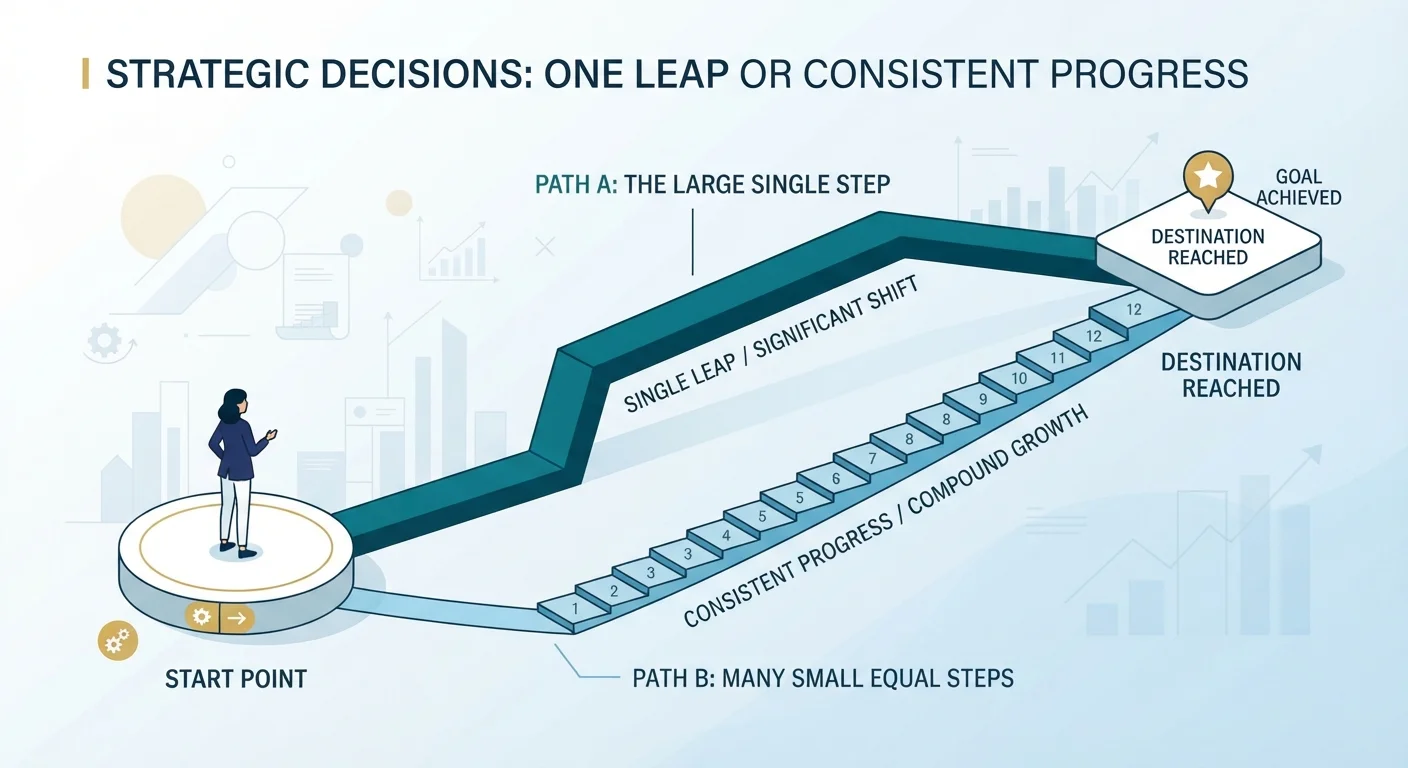
What Each Approach Actually Means
Lump sum investing means deploying a full amount of capital into the market in a single transaction. You have the money now - from a bonus, inheritance, property sale, or accumulated savings - and you invest it all at once rather than parceling it out.
Regular contributions - often called DCA, or dollar-cost averaging - means investing a fixed amount at consistent intervals: weekly, monthly, or quarterly. Each contribution purchases whatever quantity of assets that fixed dollar amount buys at the current price.
Both approaches are legitimate. Neither is inherently reckless or cautious. The meaningful differences lie in performance history, behavioral dynamics, and the practical reality of how most people accumulate money. If you're building the foundation of an investment plan, this beginner's guide to getting started covers the groundwork.
| Lump Sum | Regular Contributions (DCA) | |
|---|---|---|
| Capital requirement | Full amount available upfront | Smaller amounts at regular intervals |
| Historical performance | Outperforms in ~2/3 of scenarios | Underperforms in rising markets |
| Volatility exposure | Full exposure from day one | Spread across multiple price points |
| Behavioral difficulty | Higher - requires committing all at once | Lower - consistent, routine approach |
| Best market condition | Rising (bull) markets | Declining or volatile markets |
| Suitable for | Windfalls, inheritances, large savings pools | Paycheck-based savers, new investors |
The Performance Case for Lump Sum
Studies examining diversified market indices across decades of data generally find that lump sum investing outperforms dollar-cost averaging roughly two-thirds of the time. The logic is straightforward: markets trend upward over long periods, so money invested earlier has more time to compound. Every month capital sits uninvested waiting for scheduled contributions is a month it isn't participating in potential market growth.
This advantage is most pronounced in extended bull markets and over long time horizons. The longer the investment period, the more compounding amplifies the early-entry advantage.
~68%
Scenarios where lump sum outperforms DCA
Vanguard research examining US, UK, and Australian markets found lump sum investing outperformed dollar-cost averaging approximately two-thirds of the time over 10-year rolling periods.
2.3%
Average performance gap (lump sum vs. DCA)
The same Vanguard analysis estimated the average annual outperformance advantage for lump sum investing over a 12-month DCA schedule across three major markets.
That said, performance data reflects historical averages - not guarantees. Past market behavior does not predict future returns, and any given lump sum investment can immediately lose value if markets decline after deployment.
The Practical Case for Regular Contributions
For most working adults, lump sum investing simply isn't available as an option. Wealth accumulates incrementally through income, making regular contributions the default and sensible path. A 401(k) contribution deducted from each paycheck is DCA in its most common form.
Beyond practicality, regular contributions have a structural advantage during volatile or declining markets. Because a fixed dollar amount buys more shares when prices are lower, investors automatically accumulate more units during downturns - lowering their average cost per share over time. This is the mathematical benefit the strategy is named for.
Automate to Remove Emotion From the Equation
Setting up automatic recurring contributions - from a checking account to an investment account on a fixed date each month - removes the temptation to time the market or delay contributions during downturns. Automation turns a strategy into a habit, which is often the most powerful investment tool available to everyday savers. Many brokerage and retirement accounts allow this to be configured in minutes.
There is also a behavioral dimension. Many investors find it genuinely difficult to commit a large sum at once, particularly during uncertain economic conditions. A staged approach can reduce the psychological pressure of market timing anxiety, making it easier to stay invested rather than retreating to cash. Behavioral consistency often matters more than theoretical optimization - a point worth noting if your savings strategy needs a rethink.
How to Think About Your Own Situation
The most useful question isn't which approach is theoretically superior - it's which one you will actually follow through on. A lump sum strategy abandoned mid-course, or an investor who panic-sells after a post-investment dip, often underperforms a disciplined contributor who never wavers.
Consider the origin of your capital. Windfall money that wasn't part of your regular budget often carries less emotional weight than years of accumulated savings - which can make it psychologically easier to deploy in a lump sum. Conversely, contributing from monthly income integrates investing into cash flow naturally.
Also consider asset type. These two strategies are discussed most often in the context of equities and index funds. How index funds compare to actively managed funds is a related question worth understanding before deciding how to invest, not just when.
Whatever path you choose, time in the market - rather than the timing of your entry - remains one of the most durable principles in long-term investing. Both strategies participate in that principle; one does so immediately, the other builds toward it steadily.
This article is for general informational and educational purposes only and does not constitute personalised financial, investment, tax, or legal advice. Investment involves risk, including the possible loss of principal. Consult a qualified, licensed financial adviser before making decisions about your own circumstances.