

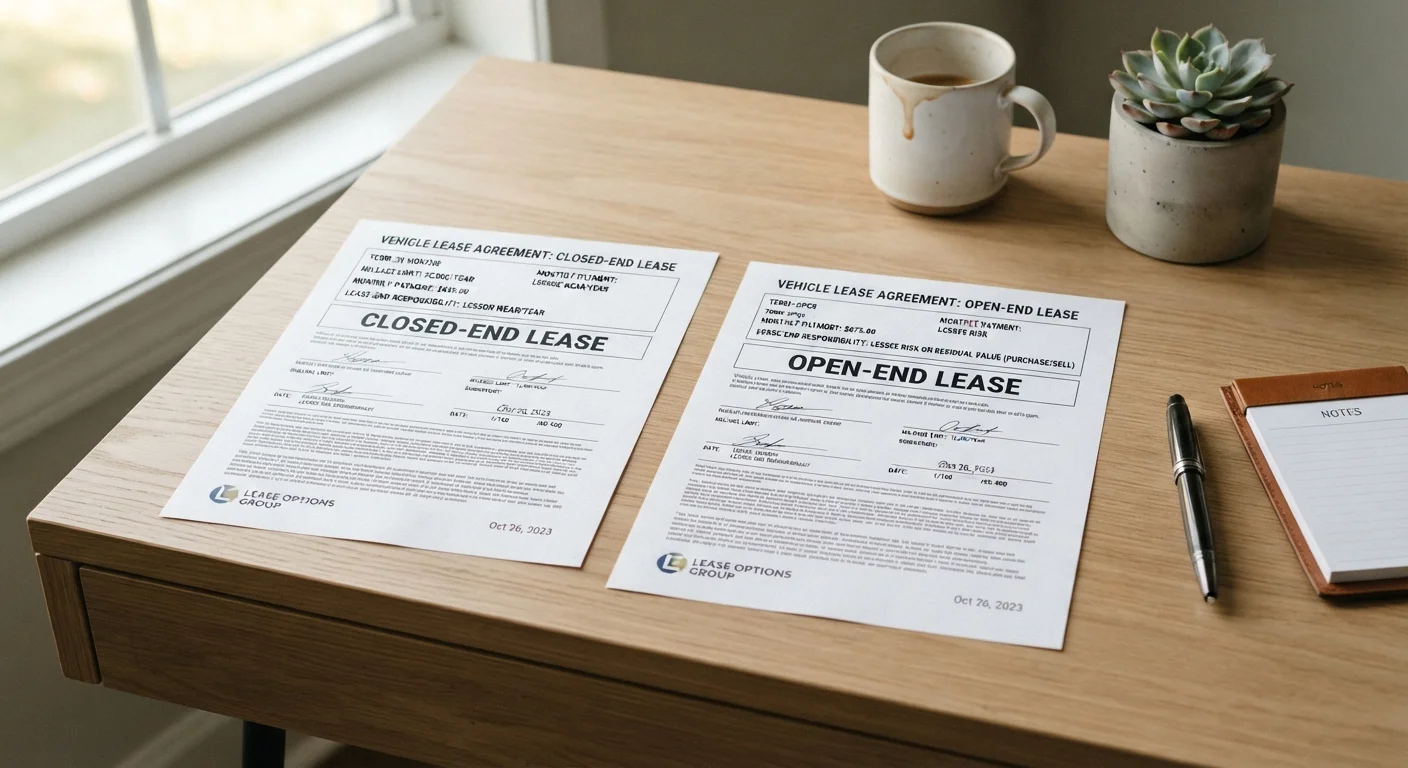
The Core Distinction: Who Bears Depreciation Risk
Every car lease is built around a residual value - the projected worth of the vehicle at the end of the lease term. The fundamental difference between a closed-end and an open-end lease is simple: which party absorbs the risk when that projection turns out to be wrong.
In a closed-end lease, the lessor (typically a captive finance arm or bank) sets the residual value at signing and guarantees it. If the car is worth less on the wholesale market when you return it, that shortfall is the lessor's problem, not yours. You walk away - provided you've stayed within mileage limits and returned the vehicle in acceptable condition.
In an open-end lease, the lessee accepts residual value risk. At term end, the vehicle is appraised. If its actual market value falls below the agreed residual, the lessee owes the difference. Conversely, if the car appraises higher, the lessee may receive a refund or credit. This structure is more common in commercial contexts, where businesses can better forecast usage and account for variable costs.
For a broader look at how lease structures compare to outright ownership, see our comparison of leasing versus buying.
| Criterion | Closed-End Lease | Open-End Lease |
|---|---|---|
| Residual value risk | Borne by lessor | Borne by lessee |
| Typical user | Individual consumers | Businesses and fleet operators |
| Mileage flexibility | Fixed cap; fees for excess | Generally more flexible |
| End-of-term liability | Limited (wear, mileage fees) | Potentially open-ended (residual gap) |
| Availability at dealerships | Standard consumer product | Rare; mainly commercial channels |
| Cost predictability | High | Variable at term end |
| Consumer protection coverage | Full Regulation M protections | Limited if structured commercially |
Closed-End Leases: How They Work in Practice
The closed-end lease is the standard consumer product at virtually every US dealership. When you negotiate terms, the dealer and finance company establish three key numbers: the capitalized cost (negotiated vehicle price), the residual value, and the money factor (the lease's interest equivalent). Your monthly payment is essentially the depreciation between those two values, plus a finance charge, spread over the term.
The critical consumer protection is the guaranteed residual. Market conditions - a sudden drop in used-car demand, a new model release that undercuts the old one's resale appeal - don't become your financial problem at return time. Excess mileage fees and charges for damage beyond normal wear are common, but these are disclosed in the contract and are finite.
Understanding every clause before you sign is essential. Our guide on reading a car lease agreement walks through each section of a standard US contract in accessible terms.
~85%
US consumer leases that are closed-end
Industry estimates consistently show the vast majority of retail passenger vehicle leases in the US follow the closed-end structure, according to automotive finance analysts.
3-4 years
Most common closed-end lease term length
36- and 48-month terms dominate the US consumer leasing market, aligning with manufacturer warranty periods and typical vehicle depreciation curves.
Open-End Leases: Structure, Risk, and Who Uses Them
Open-end leases are rarely offered directly to individual consumers at retail dealerships. They surface most often in commercial fleet arrangements, truck leasing, and high-mileage business applications where fixed mileage caps are impractical. A delivery company, for example, may not be able to predict precisely how many miles its vehicles will accumulate in a year.
The mechanics are similar - a capitalized cost, a residual estimate, and monthly payments - but the end-of-term settlement is open. If the vehicle's appraised value at return is below the stated residual, the lessee pays the gap. Federal consumer leasing regulations (Regulation M, under the Consumer Leasing Act) do provide some protections: for personal-use open-end leases, the lessee's liability for residual value deficiency is capped, and the lessor must disclose the method of appraisal. However, because most open-end leases are structured as commercial agreements, those specific consumer protections may not apply.
For businesses, open-end leases can offer tax and accounting advantages, but this is a complex area - consult a licensed tax professional or accountant for guidance specific to your situation.
Regulation M and Consumer Leasing Protections
The Consumer Leasing Act (implemented as Regulation M by the Federal Reserve and now overseen by the Consumer Financial Protection Bureau) requires lessors to disclose key terms - including residual value, total lease cost, and end-of-term liability - in a standardized format. These protections apply to personal-use leases of four months or longer with a total contractual obligation at or below the statutory threshold. Commercial leases are generally exempt, which is one reason open-end commercial leases carry more risk for the lessee.
Making the Right Call for Your Situation
For the overwhelming majority of US consumers - individuals leasing a personal vehicle - the closed-end structure is the appropriate and near-universal choice. It offers cost predictability, defined obligations, and insulation from used-car market swings. The tradeoff is adherence to mileage and condition terms; exceed those, and fees apply.
Open-end leases are a specialized instrument. Unless you are negotiating a commercial fleet arrangement or have very specific high-mileage business needs, you are unlikely to encounter one at a consumer dealership - and you should be cautious if you do, since the residual value exposure can be substantial.
Whichever structure you're considering, understanding the full range of lease advantages and limitations is worthwhile before committing. Our overview of car leasing advantages and real drawbacks provides balanced context. And when your term eventually approaches, you'll face further decisions - our article on what to do at lease end covers your options. For a complete picture of the leasing process from start to finish, the end-to-end car leasing resource is a useful reference.
This article provides general information about car lease structures for educational purposes only. It is not legal, financial, or tax advice. Lease terms, consumer protections, and commercial regulations vary by state and provider. Consult a qualified professional before entering any lease agreement.