

How ATS Software Processes Your Resume
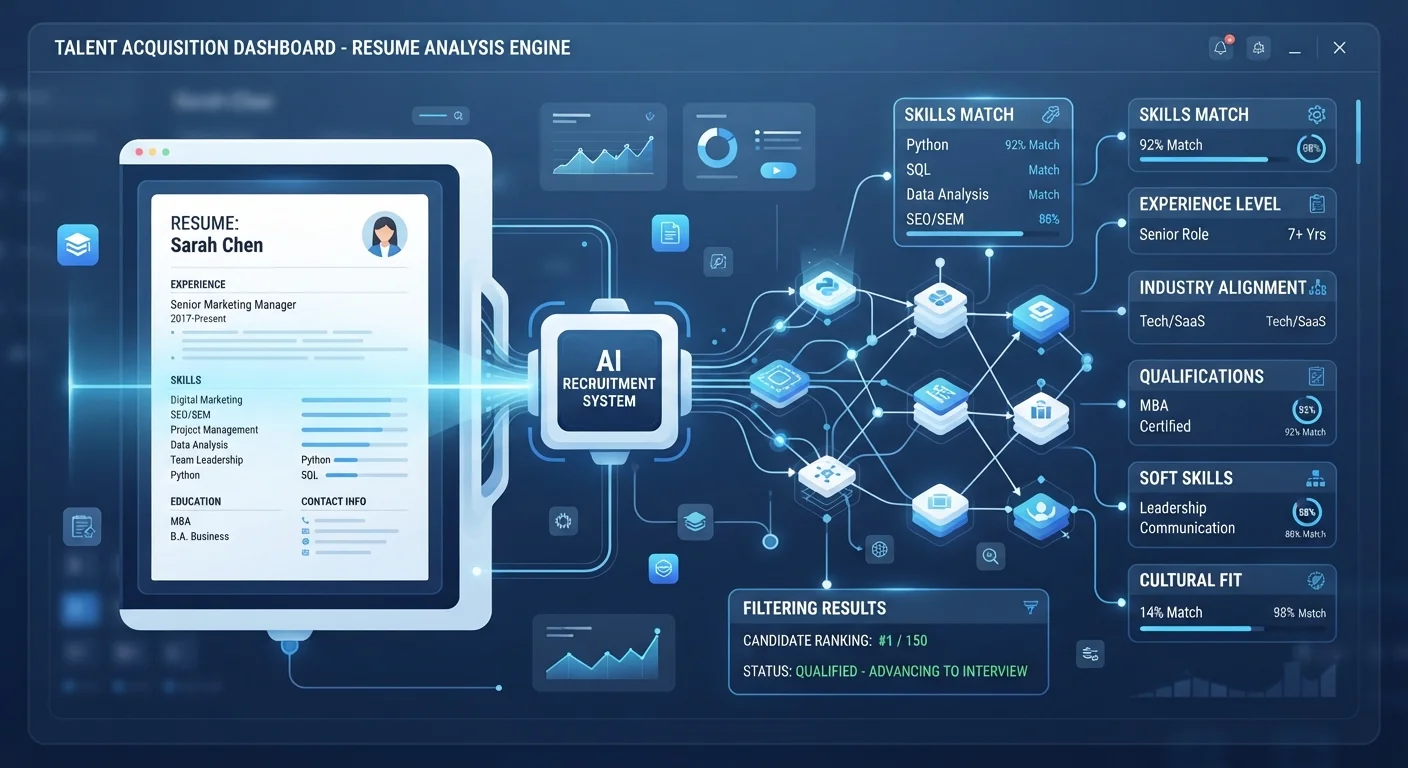
When you submit an application through an employer's careers portal, the ATS immediately begins parsing your document. Parsing means the software reads your resume and extracts structured data: your name and contact information, each job title you've held, employer names, employment dates, educational credentials, and skills. This data is stored in a database record attached to your application.
The system then compares your profile against the criteria the hiring team configured - required skills, minimum years of experience, specific credentials, or particular job titles. Depending on the platform, you receive a relevance score or are simply ranked among all applicants. Recruiters typically sort by score and begin reviewing from the top, meaning a low-ranked application may never be opened at all.
~75%
Large employers using ATS platforms
Industry research consistently estimates that a substantial majority of mid-to-large companies rely on ATS software to manage high application volumes.
Top 25%
Applications typically reviewed by recruiters first
Because recruiters sort by ATS score, candidates outside the top-ranked results are frequently deprioritized, regardless of overall qualification.
Understanding this pipeline helps explain why an identical resume can succeed with one employer and go unnoticed with another. The job posting itself is your best guide to what the ATS is measuring.
Why Formatting Can Work Against You
ATS parsers are designed to read text, not design. Resume features that look polished in a PDF - multi-column layouts, tables, text boxes, headers embedded in graphics, or icons - frequently confuse parsing engines. When a parser misreads your resume structure, your job titles, dates, or skills can end up in the wrong fields or be dropped entirely from your profile record.
The safest formatting approach is a clean, single-column document with clearly labeled sections using standard headings: Summary, Work Experience, Education, Skills. Use consistent date formatting throughout, and keep fonts standard and readable. Save your visually rich resume version for situations where you're handing it directly to a human contact.
Test Your Resume Against an ATS Parser
Several free tools allow you to paste your resume and a job description to see how well the content aligns before you submit. Running this check takes under five minutes and can reveal gaps in keyword alignment or formatting issues that are easy to fix in advance.
How to Tailor Applications for ATS Without Gaming the System
Tailoring isn't about tricking software - it's about accurately representing your experience in language the system recognizes. Start by reading the job description carefully and noting the specific terms used for skills, tools, and responsibilities. If your background matches, incorporate those exact terms into your resume where truthful and contextually appropriate.
For example, if a posting specifies "stakeholder management" and your resume says "client liaison," those may not register as equivalent to a keyword-matching ATS. Aligning your language to the posting - where your experience genuinely reflects it - is the most direct way to improve your visibility.
Before each submission, cross-reference your tailored resume against the posting one final time. The pre-application checklist is a useful structured way to do this without missing anything.
What ATS Can't Measure - and Why That Still Matters
ATS tools are effective at filtering for stated qualifications, but they cannot assess judgment, cultural contribution, communication style, or the nuanced value of unconventional career paths. This is why a qualified candidate can be screened out while a less experienced but keyword-optimized resume advances - and why the process frustrates both job seekers and recruiters.
This limitation is also why application channel matters. Weighing your application channels - job boards versus direct applications versus recruiters - is worth doing thoughtfully, because each route interacts differently with automated filtering. A recruiter who already knows your background, or an internal referral from a current employee, can place your application in front of decision-makers in ways the ATS alone doesn't govern.
Some widely repeated ideas about the job search - including beliefs about how ATS scoring works - turn out to be oversimplified. The job search myths that slow candidates down are worth reviewing so your strategy is based on how hiring actually works, not folklore.
ATS Platforms Are Not Uniform
Workday, Greenhouse, Lever, iCIMS, and Taleo - among others - each have distinct parsing behavior and scoring logic. There is no single universal formula. Focus your energy on clear formatting, accurate keyword alignment, and thorough tailoring rather than trying to reverse-engineer any specific system.