

Why the Channel You Choose Matters
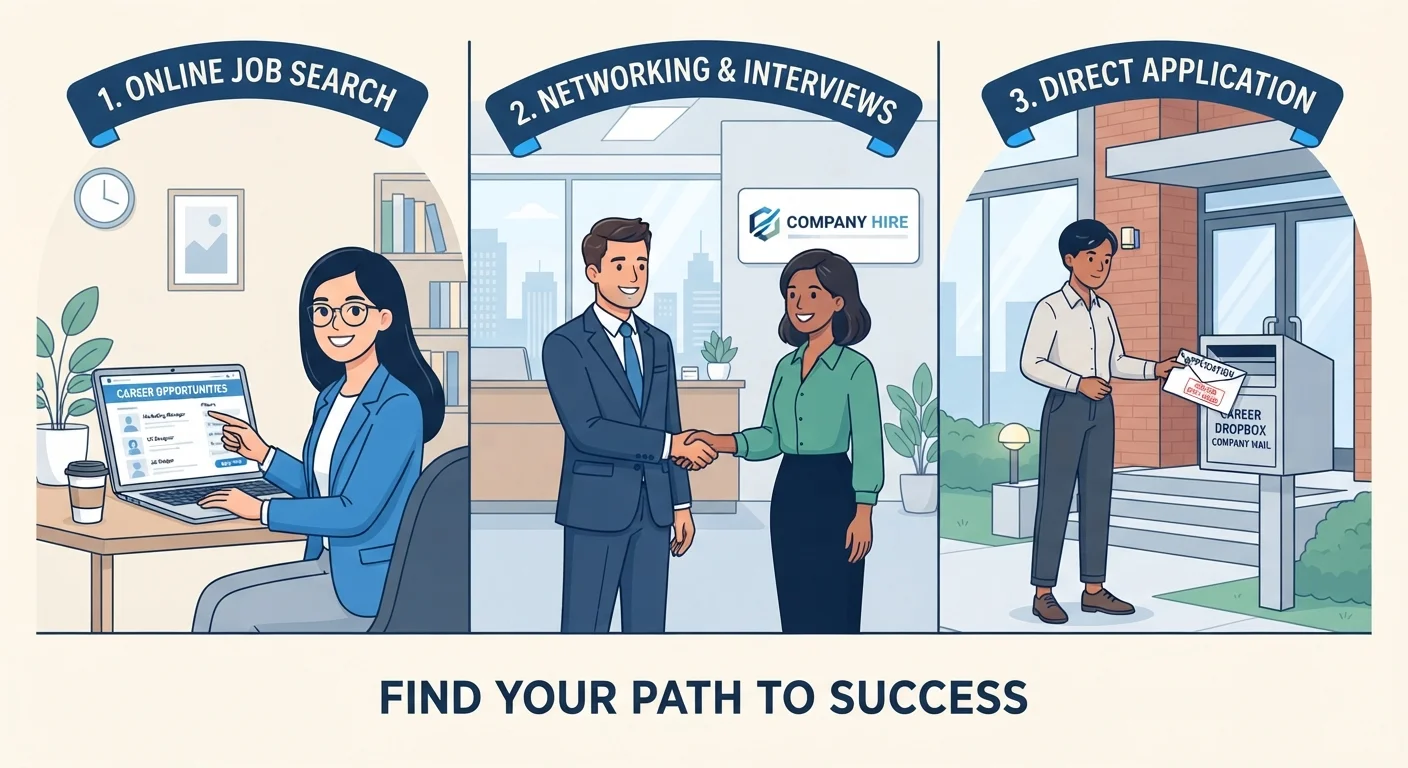
Most job seekers default to the most familiar path - typically a major job board - and treat every listing the same way. That uniformity is a strategic error. Each channel operates with different mechanics, different gatekeepers, and different signal-to-noise ratios. The role you're targeting, your seniority level, and how quickly you need to move should all shape which route you prioritize.
For a fuller picture of where channel selection fits in your overall process, see The Job Search Process, Explained from Start to Finish. This article focuses specifically on the three primary application channels and the trade-offs each one carries.
| Job Boards | Recruiters | Direct Applications | |
|---|---|---|---|
| Volume of opportunities | Very high | Moderate - curated | Low - targeted |
| Competition level | High - open to all applicants | Lower - screened pool | Lowest - proactive outreach |
| Effort per application | Low to moderate | Low - recruiter leads | High - research intensive |
| Speed to interview | Variable - ATS dependent | Often faster - direct access | Slower - no active role |
| Best seniority fit | Entry to mid-level | Mid to senior or specialist | Any - especially targeted |
| Confidentiality | High - anonymous search | Moderate - recruiter knows you | High - direct and discreet |
| Hidden market access | Low - posted roles only | High - unpublished roles common | Moderate - proactive timing |
Job Boards: High Volume, High Competition
Job boards - aggregators and platform-specific listings alike - remain the most common starting point for job seekers. Their core advantage is accessibility: a single search can surface dozens of relevant openings in minutes. For early-career candidates or those exploring across industries, that breadth is genuinely useful.
The structural downside is that the same accessibility applies to every other candidate. High-traffic listings routinely attract hundreds of applicants within days of posting, which means your resume is often processed by an Applicant Tracking System (ATS) before any human reviews it. Keyword optimization, formatting clarity, and role-specific tailoring become non-negotiable. Our guide on tailoring your CV for each application covers this efficiently.
It's also worth knowing that not every listing on a board represents an active vacancy. Some are evergreen postings used for pipeline building. Before investing significant effort in any application, learn to read the signals that a listing may not be what it seems.
Set Alerts, Don't Just Browse
Rather than manually searching boards daily, configure saved searches with email alerts for your target titles and locations. This reduces time spent browsing and ensures you see new postings early - when applicant pools are smallest and response rates tend to be higher. Review and refine your alert parameters every few weeks as your search evolves.
Recruiters: Access, Speed, and Misaligned Incentives
Working with a recruiter - whether an internal talent partner at a target company or a third-party headhunter - can significantly accelerate placement in the right circumstances. Recruiters have direct relationships with hiring managers, prior knowledge of a company's culture and unstated requirements, and sometimes access to roles that never reach public boards. This is particularly true for senior, technical, or niche positions.
The important caveat is incentive structure. Third-party contingency recruiters are paid by the employer upon a successful hire, which means their primary client is not you. A recruiter may present your profile to roles that aren't quite right if they sense a quick close is possible. This doesn't make recruiters adversarial - many are highly professional and genuinely invested in good matches - but it does mean you should stay clear on your own criteria and avoid ceding all search control to a single recruiter relationship.
For roles that exist largely outside posted listings, recruiters are often the most direct path in. See how the hidden job market works and how candidates access it for context on how much of the market operates this way.
Direct Applications: Signal, Effort, and Upside
Applying directly through a company's careers page - without an intermediary and often without a posted role - is the highest-effort channel and the one most candidates underuse. When a company is hiring but hasn't yet posted externally, a well-timed direct application can land in front of a hiring manager at exactly the right moment.
Even when roles are posted, applying via the company's own site rather than a third-party board often routes your application more cleanly into their internal system and can signal a higher level of genuine interest. Pairing a direct application with light networking inside the organization increases visibility considerably. This overlaps with the dynamics explored in networking vs. cold applying.
Direct applications require more upfront research - understanding the company's structure, priorities, and hiring patterns - but that research also makes your cover letter and resume considerably stronger. If you're conducting this search while currently employed, job searching while employed explores how to manage the added complexity.
70%
Jobs filled through networking or direct contact
Research and workforce analysts widely cite that a significant majority of roles - often estimated around 70% - are filled through relationships and direct contact rather than public postings, though exact figures vary by sector and source.
250+
Average applicants per corporate job posting
Recruiting platform data has consistently shown that popular corporate listings on major job boards can attract hundreds of applications, intensifying ATS screening pressure on candidates.
Building a Multi-Channel Strategy
The most effective job searches treat these three channels as complementary rather than competing. A practical allocation might look like this: use job boards to maintain awareness of what's actively hiring in your target market; engage one or two sector-specific recruiters for roles above a certain seniority threshold; and reserve direct outreach for a focused shortlist of five to ten companies you'd genuinely prioritize.
Tracking all three channels simultaneously demands organisation. If you're juggling multiple applications across sources, keeping your job search organised offers practical systems to avoid letting anything fall through. And if you're weighing whether to look externally at all, internal mobility versus external job searching provides a structured comparison of both paths.
Ultimately, the right channel mix is contextual - not fixed. Revisit your allocation as your search evolves, and adjust based on what's producing responses rather than sticking with familiar habits out of inertia.