

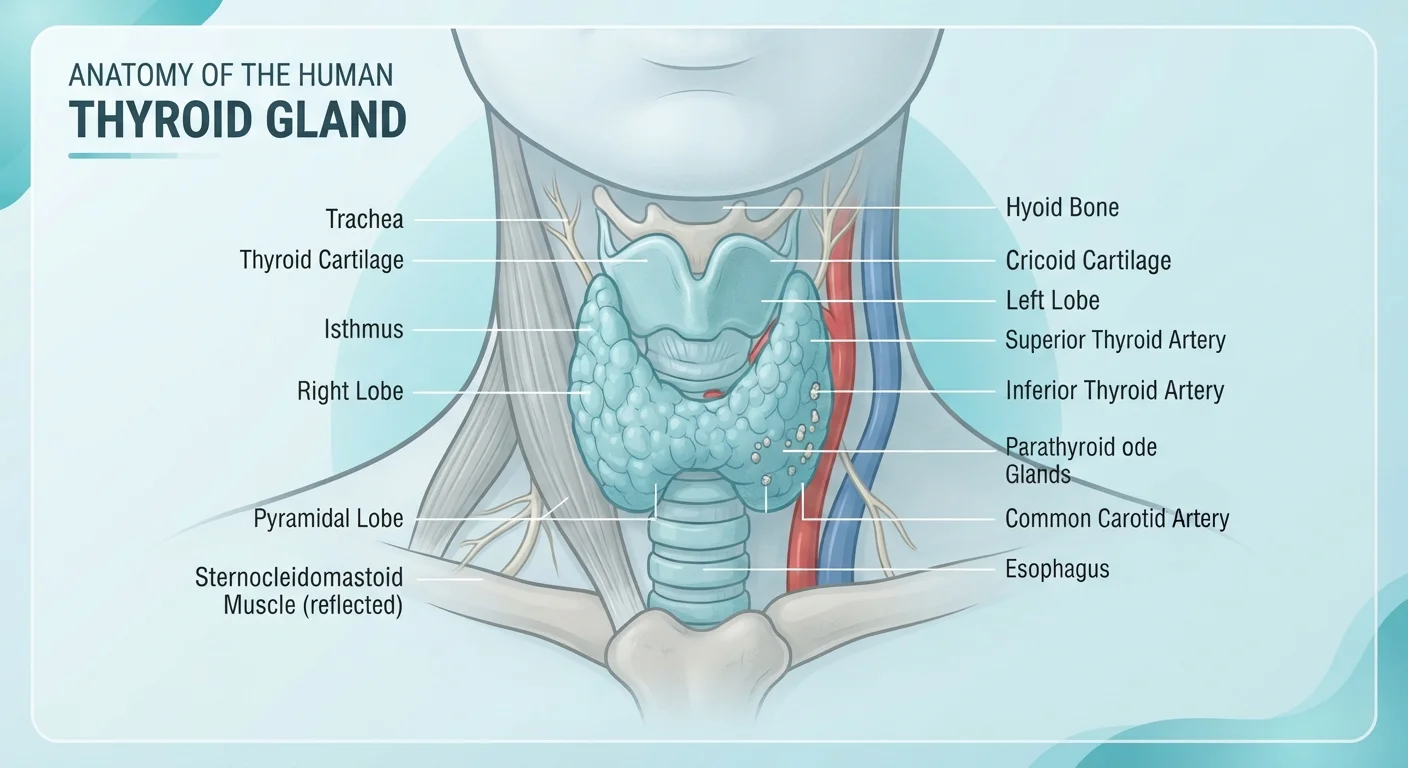
How the Thyroid Gland Works
The thyroid is a butterfly-shaped gland located at the base of the neck, just below the larynx. Despite weighing only about an ounce, it exerts influence over virtually every cell in the body by producing two primary hormones: thyroxine (T4) and triiodothyronine (T3). These hormones govern metabolic rate, body temperature, heart rate, digestion, and even mood regulation.
Thyroid hormone production is regulated by a feedback loop involving the hypothalamus and the pituitary gland. The pituitary releases thyroid-stimulating hormone (TSH), which prompts the thyroid to produce T4 and T3. When hormone levels are sufficient, TSH output decreases - a classic negative feedback mechanism. Disruption at any point in this axis can lead to measurable thyroid dysfunction.
~20 million
Americans with a thyroid condition
The American Thyroid Association estimates that approximately 20 million Americans have some form of thyroid disease.
60%
Unaware of their thyroid condition
According to the American Thyroid Association, up to 60% of those with thyroid disease are undiagnosed or unaware of their condition.
5-10x
Higher risk in women vs. men
Women are five to ten times more likely than men to develop a thyroid disorder, per published epidemiological data.
Hypothyroidism: An Underactive Thyroid
Hypothyroidism occurs when the thyroid produces insufficient hormone, slowing many of the body's processes. It affects an estimated 5% of Americans aged 12 and older, according to the National Institute of Diabetes and Digestive and Kidney Diseases (NIDDK), with prevalence increasing with age and disproportionately affecting women.
Common Causes
- Hashimoto's thyroiditis: An autoimmune condition in which the immune system attacks thyroid tissue; the leading cause of hypothyroidism in the United States.
- Prior thyroid surgery or radioiodine therapy for hyperthyroidism or cancer.
- Certain medications, including lithium and amiodarone.
- Iodine deficiency, rare in the US but a global concern.
Recognizing Symptoms
Because thyroid hormones regulate so many systems, symptoms of hypothyroidism are broad and often develop gradually. They include persistent fatigue, unexplained weight gain, cold intolerance, constipation, dry skin, hair thinning, slowed heart rate, depression, and cognitive fog. These symptoms overlap with many other conditions, which is why laboratory testing - not symptoms alone - is essential for diagnosis.
Symptom Overlap Can Lead to Missed Diagnoses
Hypothyroidism symptoms such as fatigue, weight changes, and low mood are shared by many other conditions, including depression, anemia, and sleep disorders. This overlap means thyroid dysfunction is sometimes attributed to lifestyle factors or mental health before testing is performed. If you have persistent or unexplained symptoms affecting multiple body systems, ask your healthcare provider specifically about thyroid function testing.
Hyperthyroidism: An Overactive Thyroid
Hyperthyroidism is the opposite condition: the thyroid produces excess hormone, effectively accelerating bodily functions. It is less common than hypothyroidism, affecting roughly 1.2% of the US population, per NIDDK data.
Common Causes
- Graves' disease: The most common cause, an autoimmune disorder in which antibodies stimulate excess hormone production.
- Toxic nodular goiter: One or more autonomous nodules that produce hormone independently of TSH control.
- Thyroiditis: Inflammation that temporarily releases stored hormone into the bloodstream.
- Excess iodine intake or certain medications.
Recognizing Symptoms
Symptoms of hyperthyroidism often mirror anxiety and cardiovascular conditions: rapid or irregular heartbeat (palpitations), unintentional weight loss despite increased appetite, heat intolerance, excessive sweating, tremor, irritability, and difficulty sleeping. Graves' disease may also cause a distinct eye condition called Graves' ophthalmopathy, involving eye bulging and irritation.
If your clinician identifies atrial fibrillation or unexplained heart palpitations, ask whether a TSH test has been ordered - subclinical hyperthyroidism is a recognized but often overlooked contributor.
Excess thyroid hormone has direct effects on cardiac conduction, and thyroid-related arrhythmias may be reversed with appropriate thyroid treatment rather than antiarrhythmic drugs alone.
When tracking your thyroid labs over time, request copies of your actual TSH values - not just a 'normal' or 'abnormal' result - so you and your provider can detect meaningful trends before symptoms appear.
TSH has a wide reference range; an individual's optimal set-point may sit within a narrower zone, and trending values over time often reveals subclinical changes earlier than single-point comparisons.
Other Thyroid Conditions
The thyroid spectrum extends well beyond the hypo/hyperthyroid binary. Several other conditions deserve attention:
Thyroid Nodules
Nodules - lumps within the thyroid - are extremely common, detected in up to 65% of the general population through imaging, according to the American Thyroid Association (ATA). The vast majority are benign. However, a small percentage are malignant, so clinicians use ultrasound characteristics and, when indicated, fine-needle aspiration biopsy to assess risk.
Thyroid Cancer
Thyroid cancer is among the more treatable cancers when detected early. Papillary thyroid carcinoma is the most common type, accounting for roughly 80-85% of all thyroid cancers per ATA data. Treatment typically involves surgery, sometimes followed by radioiodine therapy, depending on the type and stage.
Goiter
A goiter is simply an enlarged thyroid gland. It can occur in both hypothyroid and hyperthyroid states, as well as in people with normal thyroid function. The size of the gland does not automatically indicate the level of its hormonal activity.
Thyroiditis
Thyroiditis refers to inflammation of the thyroid from various causes - viral illness, autoimmune activity (as in Hashimoto's), or postpartum hormonal shifts. Postpartum thyroiditis affects approximately 5-10% of women in the year following delivery and can cycle through hyperthyroid and hypothyroid phases before resolving.
Postpartum Thyroid Changes Require Monitoring
Postpartum thyroiditis can mimic postpartum depression or anxiety, and its thyroid-driven origin may be missed without lab testing. Women experiencing significant mood changes, fatigue, or palpitations in the months after delivery should discuss thyroid function evaluation with their healthcare provider. Special-population care applies: always consult a qualified professional regarding postpartum health decisions.
Diagnosis and When to See a Doctor
Thyroid disorders are diagnosed primarily through blood tests. A serum TSH test is the standard first-line measure: an elevated TSH typically signals hypothyroidism (the pituitary is working harder to compensate), while a suppressed TSH suggests hyperthyroidism. Free T4 and, in some cases, free T3 levels are measured alongside TSH to clarify the picture. Thyroid antibody tests (such as anti-TPO antibodies) help identify autoimmune causes like Hashimoto's or Graves' disease.
Imaging - thyroid ultrasound or a radioactive iodine uptake scan - is used when nodules, goiter, or the cause of hyperthyroidism needs further characterization, not as a routine screen for hormonal disorders.
Individuals should seek evaluation from a healthcare provider if they experience persistent unexplained fatigue, significant changes in weight or heart rate, a visible neck swelling, or any combination of the symptoms described above. Primary care physicians routinely evaluate thyroid function; endocrinologists specialize in complex or refractory cases.
Subclinical Thyroid Dysfunction Is Common
Subclinical hypothyroidism - defined as an elevated TSH with normal free T4, often without obvious symptoms - is detected in approximately 4-8% of the general population. Whether and when to treat it depends on TSH level, symptoms, age, cardiovascular risk, and pregnancy status. This is an area of ongoing clinical discussion, and decisions should be made collaboratively with a healthcare provider rather than based on lab values alone.
General Management Approaches
Management of thyroid disorders varies substantially by condition, severity, and individual patient factors. The following reflects general, publicly established approaches - treatment decisions must be individualized by a qualified clinician.
Hypothyroidism
The standard treatment for persistent hypothyroidism is daily oral levothyroxine, a synthetic form of T4. Dosing is carefully titrated using TSH monitoring, often over weeks to months, and requirements may change with age, weight, pregnancy, or other medications.
Hyperthyroidism
Options include antithyroid medications (such as methimazole) that reduce hormone production, radioiodine therapy that permanently reduces gland activity, or surgery to remove part or all of the gland. Beta-blockers may be used short-term to manage symptoms such as palpitations. The choice among these approaches depends on the underlying cause, disease severity, patient age, and reproductive status, among other factors.
Nodules and Cancer
Many benign nodules require only periodic monitoring with ultrasound. Confirmed or highly suspicious thyroid cancers are typically managed surgically by a specialist team. Thyroid cancer survivorship and follow-up care require long-term coordination with an endocrinologist.
Lifestyle Considerations
While no diet or supplement has been proven to treat thyroid disorders, adequate iodine intake from food remains important for thyroid health in the general population. People on levothyroxine should be aware that certain foods (notably high-fiber foods and soy) and supplements (calcium, iron) can interfere with medication absorption when taken simultaneously - a practical point to discuss with a pharmacist or physician.
This article is for general informational and educational purposes only and does not constitute medical advice. Thyroid conditions require professional diagnosis and individualized management. If you have concerns about your thyroid health, please consult a qualified healthcare provider.