

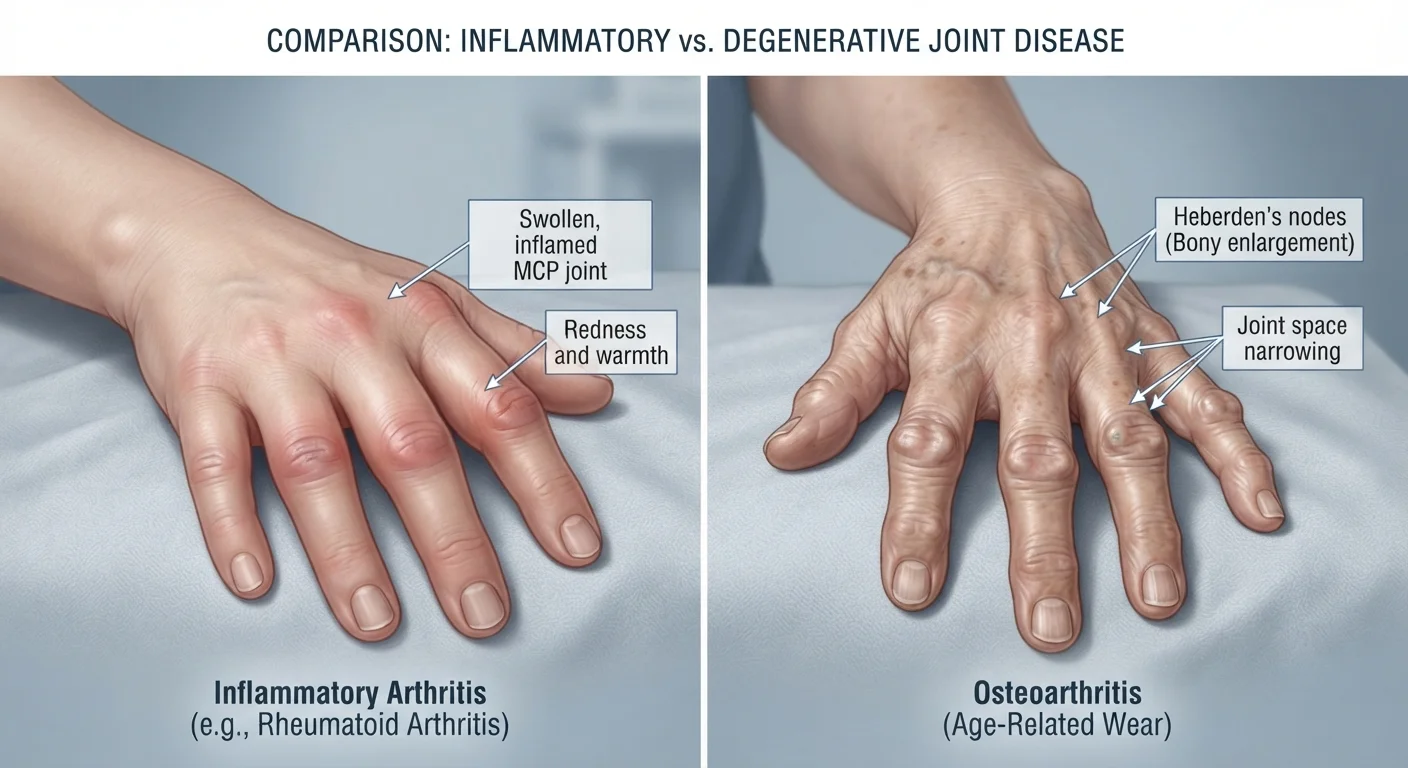
What Sets These Two Conditions Apart
Arthritis is an umbrella term covering more than 100 joint conditions, but osteoarthritis (OA) and rheumatoid arthritis (RA) are among the most commonly diagnosed - and commonly confused. Despite sharing joint pain as a core symptom, their underlying causes are fundamentally different.
Osteoarthritis is a degenerative joint disease in which the protective cartilage cushioning the ends of bones gradually wears down. This process is strongly associated with aging, prior joint injuries, obesity, and repetitive mechanical stress. OA most often affects the knees, hips, hands, and spine.
Rheumatoid arthritis, by contrast, is an autoimmune disease. The immune system mistakenly attacks the synovial membrane - the tissue lining the joints - triggering chronic inflammation that can damage cartilage and bone over time. RA tends to affect joints symmetrically (both wrists, both knees), and it can also involve organs beyond the joints, including the lungs and heart.
| Osteoarthritis (OA) | Rheumatoid Arthritis (RA) | |
|---|---|---|
| Underlying cause | Cartilage degeneration (mechanical/aging) | Autoimmune - immune system attacks joints |
| Typical onset age | Usually over 50 | Often 30-60, but any age |
| Joint pattern | Asymmetric, weight-bearing joints | Symmetric, including small hand/wrist joints |
| Morning stiffness | Less than 30 minutes | 60 minutes or longer |
| Systemic symptoms | Rarely present | Fatigue, fever, general illness common |
| Key diagnostic tools | X-ray, physical exam | Blood tests (RF, anti-CCP), imaging |
| Primary treatment | Pain relief, PT, lifestyle changes | DMARDs, biologics, early intervention |
Symptoms: Overlaps and Key Differences
Both conditions cause joint pain and stiffness, which contributes to diagnostic confusion. However, the character and timing of symptoms differ in clinically meaningful ways.
- Morning stiffness: In OA, stiffness typically improves within 30 minutes of movement. In RA, morning stiffness commonly persists for an hour or longer and is considered a diagnostic indicator.
- Joint pattern: OA frequently begins in a single joint or joints on one side of the body. RA usually presents symmetrically - if one wrist is affected, the other typically is as well.
- Swelling type: OA-related swelling often involves bony enlargements (Heberden's or Bouchard's nodes in the fingers). RA swelling tends to feel soft and warm due to synovial inflammation.
- Systemic symptoms: Fatigue, low-grade fever, and a general sense of illness are common in RA but are not characteristic of OA.
Track Your Symptoms Before Your Appointment
Keeping a simple log of when joint pain occurs, how long morning stiffness lasts, and which joints are affected can meaningfully improve the diagnostic conversation with your healthcare provider. Note any fatigue, swelling, or warmth around joints as well. This information helps clinicians distinguish between OA and RA more efficiently.
Diagnosis and Who Is Affected
OA predominantly affects adults over age 50, though it can occur earlier following joint injury or in individuals with certain genetic predispositions. According to the Centers for Disease Control and Prevention (CDC), OA is the most common form of arthritis in the United States, affecting an estimated 32.5 million adults.
RA can develop at any age, including in children (where it is called juvenile idiopathic arthritis), but it most commonly emerges between ages 30 and 60. It is approximately two to three times more prevalent in women than men, according to the American College of Rheumatology.
Diagnosis relies on a combination of clinical history, physical examination, imaging (X-rays, MRI), and blood tests. RA-specific markers such as rheumatoid factor (RF) and anti-cyclic citrullinated peptide (anti-CCP) antibodies help distinguish it from OA, though some RA cases are seronegative (without detectable antibodies).
32.5M
U.S. adults living with osteoarthritis
According to the Centers for Disease Control and Prevention (CDC), OA is the most common form of arthritis in the United States.
1.5M
Americans affected by rheumatoid arthritis
The American College of Rheumatology estimates approximately 1.5 million people in the U.S. have rheumatoid arthritis.
2-3×
Higher RA prevalence in women than men
Rheumatoid arthritis disproportionately affects women, with estimates suggesting two to three times the rate compared to men.
Treatment Approaches
Because OA and RA have different causes, their management strategies also diverge - reinforcing why an accurate diagnosis matters before any treatment plan is followed.
For OA: Management typically centers on physical activity, weight management, physical therapy, and pain relief. Nonsteroidal anti-inflammatory drugs (NSAIDs) and topical analgesics are commonly used. In more advanced cases, joint replacement surgery may be considered. There is no treatment that reverses cartilage loss.
For RA: Disease-modifying antirheumatic drugs (DMARDs), including methotrexate, are foundational to treatment. Biologic agents targeting specific immune pathways have significantly improved outcomes for many patients. Early, aggressive treatment is emphasized to slow disease progression and preserve joint function. Corticosteroids may be used short-term to control flares.
Both conditions benefit from a multidisciplinary approach including rheumatology, physical therapy, and lifestyle modifications. Self-management education and regular follow-up care are integral to living well with either diagnosis.
This article is for general informational and educational purposes only and does not constitute medical advice. If you are experiencing joint pain or other symptoms, consult a qualified healthcare professional for an accurate diagnosis and personalized care plan.